How to Maximize an Incubator Experience

In yesterday’s VentureBeat post, entitled “15 Entrepreneurs Give Tips on Getting the Most Out of an Incubator or Accelerator,” the following  insights were offered:

Do your research to find the right fit

You should do your homework on any accelerator you’re considering. What do they offer? What are some of their success stories? What happens to companies that don’t succeed? How often do their teams get funded? Depending on the accelerator you join, you’ll get very different answers to those questions. Make sure to not only talk to the accelerator but also past companies, both successful and not.

Jason Evanish (@Evanish), Greenhorn Connect

Don’t be a perfectionist and accept the guidance

I think these groups are really important to early-stage startup attempts — the mentorship, community, and exposure they offer far outweigh any equity you might share with them in return. Don’t get caught up in trying to build something perfect; focus your efforts on customer development and proving your assumptions, so they can help you move that learning into a solid first product.

Derek Shanahan (@dshanahan ), Foodtree

Accomplish something on your own first

After having a detailed discussion with TechStars graduate and Contently.com co-founder Shane Snow, my takeaway was to have built an impressive resume of personal accomplishments to show you’re capable of actually building a real business. Incubators and accelerators want to train entrepreneurs, but they need to make sure you’re coachable and have actual potential to become a real star.

Danny Wong (@blanklabel), Blank Label Group

Be prepared to immerse yourself and go all in

You need to dedicate your time into this — it’s an endeavor that requires focus 24/7. Also, look at the opportunity as a time to find the right co-founder, strategic partners, and to be honest and upfront with the organizers about what you need. The more you give, the more you get!

Ash Kumra (@AshKumra ), DesiYou

Prove that you are committed

Demonstrate commitment and focus on results; incubators and accelerators invest in people and teams more than markets. It’s important to have a disruptive idea, but the drive and capabilities of the team are much more correlated to success than the size of the market or details of the business plan. They want to see a smart, dedicated team that is passionate about executing.

John Harthorne (@jharthorne), MassChallenge

Don’t settle for any incubator, find the best

If you are thinking of applying to an incubator or accelerator, be sure to find the best. Even if you have to give up a larger portion of your company, it will be worth it for the amount of growth it will help you with in comparison to a lesser organization. Also, look for synergy and people whom you work well with — you want to feel welcomed into your new home.

Louis Lautman (@louislautman), Young Entrepreneur Society

Make sure your goals match up

All incubators and accelerators are not created equal. Some incubators focus on landing funding, others focus more on helping you build a revenue-generating firm. Make sure your goals align with that of your program.

Doreen Bloch (@DoreenBloch), Poshly Inc.

Reach out to alums

Before applying to an accelerator program, I would talk to alums of the program to make sure they had a good experience. It also might help if you could get some time to validate your idea for a business before jumping into one of these programs. Make sure the “proof of concept” even makes sense.

Patrick Curtis (@WallStreetOasis ), WallStreetOasis.com

Perfect your pitch

Many incubators are looking for the entrepreneur to make some type of pitch, so it’s important to practice, practice, practice. The more excited that you can make them about your concept, the higher likelihood that you will get accepted to the accelerator.

Lawrence Watkins (@lawrencewatkins), Great Black Speakers

Paint a picture of success

When creating your pitch, keep in mind that you want to convince the judges that your startup is truly going places. It’s going to be so successful that they will want to attach their name to get behind it. Show them that you’re going to be successful no matter what, so it’s in their best interest to have you affiliated with their program.

Stephanie Kaplan (@stephaniekaplan), Her Campus Media

Tell a great story

Remember, people are investing in you more than your idea. Businesses are fluid in the startup stage. Which means your personality and background is what really counts. While pedigree or experience matter, your curiosity, obsession and commitment matter more. Character trumps credentials. What’s the riddle you’re trying to solve? How have you overcome failure? Make them believe in you.

Michael Margolis (@getstoried), Get Storied

Master the art of explaining your idea clearly

Good entrepreneurs know a lot about their business and their market. But can you communicate this expertise in a way that resonates with decision-makers in the incubator and accelerator programs? Start by reading “The Art of the Start” by Guy Kawasaki and learn the “business of business communication” in the startup phase.

Kent Healy (@Kent_Healy), The Uncommon Life

Timing is everything

Think about what you aim to get out of the incubator or accelerator program in mind. People tend to assume that these are great kickstarters, and they can be, but it all depends on timing. Joining one at the wrong stage of your cycle can be feedback overload, or slow your growth in other ways. Sometimes you need to collect input and test your idea, and sometimes you just need to build.

Caroline Ghosn (@carolineghosn ), The Levo League

Don’t join on your first venture

Entrepreneurs are going to make mistakes and get things wrong more often than not. I suggest getting as much accomplished in the real world before applying for incubation. The more you can do before you need the help, the better your terms will be and the more serious they will take your application.

Lucas Sommer (@audimated), Audimated

There’s life after an accelerator

These are great opportunities, but your business must happen with or without them. It’s easy to get caught up in the excitement and the aspiration of being accepted to a “prestigious program” — after all, it’s validation that you’re on to something! But if things don’t work out, the show must go on. Your goal is to create a company, so don’t lose sight of the bigger picture.

Tony Navarro (@hoostony ), Streamcal


Start-Up Savvy: Taught & Caught

Image

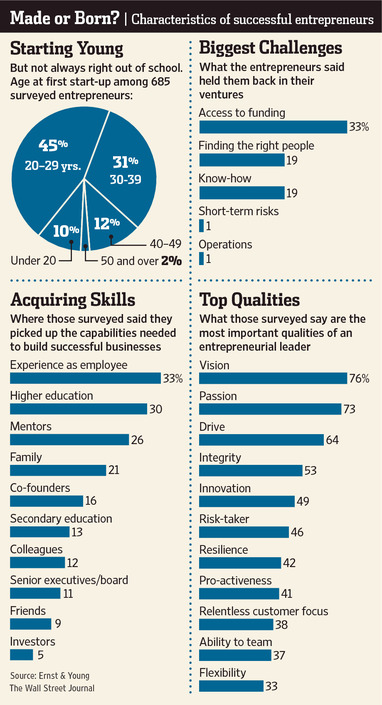
In an article last month entitled, “Can Entrepreneurship Be Taught?,” two sides of the argument were presented that, while equally valid, were at odds with one another. Noam Wasserman, Harvard Business School professor of Entrepreneurship and author of “The Founder’s Dilemmas: Anticipating and Avoiding the Pitfalls That Can Sink a Startup,” takes the position that too many founders have to climb the same steep learning curve as others before them, bereft of insights that could help great ideas become great businesses. Victor Hwang, co-author of “The Rainforest: The Secret to Building the Next Silicon Valley” and managing director of T2 Venture Capital in Silicon Valley, posits that only experience can teach an entrepreneur how to successfully launch a business.

Within the Wasserman camp are educators who believe that documented best practices and potential problem areas can be shared with the entrepreneurs. For instance, the idea that the founder must do the three following things has been challenged with research data to instruct otherwise:

  1. Following one’s gut
  2. Having a “glass half full” view about resources and time
  3. Stay in the top executive role as the company matures

Augmenting the classroom instruction with deliberate opportunities to “try out” a principle in a role play seem to yield good results. Additionally, self assessments are helpful in increasing one’s self awareness and ability to lead others. Notably mentoring is recognized as one of the best ways an entrepreneur can learn how to do the right thing in a myriad of scenarios.

What is also being learned is the need to not just offer principles of management (regardless the field of management–finance, operations, marketing, etc), but to also focus on the soft skills requisite to be an effective leader. Whether the entrepreneur is embracing better social skills, motivational techniques for self and others, or other facets of emotional intelligence, there are competencies to be gained that are simply not intuitive for most.

Hwang and the experiential learning community holds steadfastly to the conviction that entrepreneurship is taught rather than caught and is more of  an impartation than an education. Rather than the typical domain of business schools–resource allocation and risk management, it is argued that the necessary skills fall more into the following categories:

  • Comfort with a high degree of uncertainty
  • Willingness to become a generalist rather than a specialist
  • Abilities in inspiring others through storytelling and personal charisma

Since some programs are heading in the direction of trying to advise start-ups on what actions to avoid, Hwang is concerned that the willingness to try something unconventional may become minimalized. He and others believe that such a mindset is critical to entrepreneurial success. The main thesis behind Hwang’s proposed approach is that entrepreneurs would have the greatest chance of success if communities with resources, counsel and mentoring were available for their growth and development.

The common theme, then, is that mentoring and nurture is the best medicine for someone who “suffers” from entrepreneurial dreams. We wholeheartedly concur with this bottom line approach and advocate innovation centers (incubators with assigned mentors, education, and planned activities to build a sense of community) as a best practice!

Better Than Dilution & Debt

One of the most interesting websites we’ve discovered recently about entrepreneurs is called Under30CEO. Today the site featured an interview with Trevor Mauch, founder of AutomizeIt and Mach One Media, serial entrepreneur and founder of a few multimillion dollar businesses. Excerpted from the interview is the quoted section below:

One of the things I see a lot of people I’m coming across, they’re making the funding part (of entrepreneurship) out to be a huge deal [when it’s not.] As a great example…this guy was selling his linen [or garment] business services for hotels or whatnot. He bought his equipment for 500 bucks. And this guy bought this equipment, and then he went to the biggest account in town, which is our local hospital and said “what do I have to do to have your business?” (After he heard the answer,) ..he said “okay, I can’t do all of this capacity right now but if you fund $25,000 to get into a facility and to buy our equipment that can service ..what you need, then will accept this bid.”  …The hospital..it’s like (a) $15,000 – $20,000 dollar a month account! ..The hospital ended up going with this guy and funded the whole growth of his business!

..With two of my different businesses, …we saw what people wanted, and we went out there and pre-sold one of our training programs before it was ever created! We made sure that people wanted it, made sure it’s really quality, and we pre-sold to our customers, and our customers funded that startup.  And same thing with our software company.  We funded that company with our revenues from the publishing company, and same thing we went out there before we were finished. We pre-sold memberships in it and that help us get some cash to start that goal. So yeah definitely don’t look at funding as an obstacle because there’s a lot of different ways to get funding, especially from your customers, and sites like Kickstarter.

(At Kickstarter) anybody can go there and post their project, their business or products whatever their looking at launching. And they raise funds for their business by getting people to “pre-buy” whatever it is. So, I was last week and uhmm there’s this one [business], that was some kind an iPod speaker and so they had a prototype…they sold a prototype and said “that’s what you’re gonna get,” and they had a goal they wanted to raise, I think that one is about $50,000 bucks. And they raised their $50 grand in about 14 days after they started, just from people seeing this idea and jumping pre-buying one of the things from it!! And that’s just a killer model.

So, the moral of the story is…become creative in your approach to funding your business! It’s not necessary to run up exorbitant credit card debt, nor follow the angel-VC-dilution pattern. Mauch started his first business with $600 cash. Stretch your mind–think hard about how you can accomplish your objectives without copying someone else’s success path. You will be so happy you did when it’s your turn to be interviewed.

Bureaucracy: The Entrepreneur’s Kryptonite

As Dan Sullivan says in The Strategic Coach® Program, “The human brain cannot do extraordinary things, only normal things.” “So the trick,” he says, “is to make the extraordinary normal.”

Corporate employees operate based on policy: that’s what keeps them from having to think. Entrepreneurs depend thrive on having the freedom to constantly grow and change, to make new connections, and to ask questions that shake everything up. To an entrepreneur, groupthink (i.e. bureaucracy) is like Kryptonite.

Just because we don’t like being bogged down by over reliance on structure doesn’t mean that we are always creative. Following established patterns and trying to approach every issue with the same solution is a bad habit even for an entrepreneur. Rather than seeing opportunity, we can become fixated on solving a problem.

When Jim Collins wrote about Big Hairy Audacious Goals (“BHAGs”), he was challenging small thinking. Simply considering an aggressive goal causes the mind to see the environment differently. Unable to stop thinking about the “What ifs,” we are empowered to consider new concepts,  linkage and alternative ways of viewing the same issue. Divergent thinking is modeled by the likes of Richard Branson, who tweeted, “My interest in life comes from setting myself huge, apparently unachievable challenges, and trying to rise above them.”

Your definition of “normal” daily experience becomes unique when you think in terms of BHAGs.  Dream for a moment about what life could look like in 5-7 years. Can you imagine performing at 10x today’s level? Earning 10X what you do today?

Bureaucracies are based on keeping everything the same so they can preserve their status. Policy and rules “protect” the structure from the effects of individuals, whose participation is measured in hours on the clock, not in results. In an entrepreneurial organization, by contrast, change is life, because “holding your ground” means stagnating and falling behind. Individuals are sought out and rewarded for their ability to think, create, and make a unique contribution.

Make a habit of  what Sullivan terms the “10x Mindset,” and innovation, risk-taking, and teamwork will all come together for you in a completely new way. Bureaucratic thinking and structures simply won’t survive in your environment because you and the people around you will be entirely focused on building, adapting, and expanding a path toward your “bigger future” vision.

Cultivate a creative mindset that makes growth and progress “normal.”

What Entrepreneurs Should NOT Do

When entrepreneurs start businesses, they are susceptible to making mistakes that others have made before them, climbing an unnecessarily steep learning curve, and burning through dollars and emotional energy. Without the help of an experienced mentor and some principles of start-up management, it is no wonder that many start-ups are not in existence 5 years later. Yes–success stories abound–mainly because few want to read or write about businesses that didn’t make it!

David Bakke is a writer for Money Crashers, and was featured on Brazen Life, a Brazen Careerist site recently with the list below of mistakes an entrepreneur should seek to avoid (& can with mentoring and education): http://ow.ly/ataho

1. Starting a business in a new field

Trying to launch a business in an industry or area where you don’t have any prior experience can quickly lead to failure. Before you make the leap into starting a business, make sure you focus on your talents, passion and experience to pinpoint the right business for you. Combine your enthusiasm, experience and knowledge with a solid, organized business plan if you really want to succeed.

2. Trying to start your business on your own

Trying to go it alone will only hamper your efforts to grow and expand your business. Initially it makes sense to cut costs by working alone, but soon enough you’ll need to make intelligent, calculated decisions about working with like-minded individuals to help your business grow.

3. Not adapting to changing business conditions

Learn to adapt as you grow your business. Don’t be afraid to change your target market or scrap unsatisfactory marketing initiatives. Recognize the fluidity of your small business, focus on what positively and negatively affects your business plan, and adjust your growth model accordingly.

4. Being deathly afraid of making mistakes

You engage in a great deal of risk when you launch a small business, and most of it involves your personal finances. Learn to quickly identify errors in judgment, determine why they occurred, and make immediate adjustments so they don’t happen again.

5. Avoiding risk

Continue to take risks as your business evolves. If you encounter an idea to expand your business that feels “risky,” research the pros and cons of the concept. If the idea still seems viable after your analysis, go for it!

6. Quitting if you run out of cash

No successful entrepreneur ever let money stand in the way of achieving business goals. If you have a great business plan, a passion for the concept, and you’re willing to work hard, you can always find ways to fund your business proposition. Cut costs in your everyday life to free up capital, apply for an SBA loan, approach angel investors, or even approach friends and family after you’ve bootstrapped as much as you can.

If you can’t find funding, you don’t have to give up on the business idea altogether. Timing also plays a role in business success. It might make sense to start more slowly, and to put off aggressive expansion efforts and attempts to find additional funding until your business begins to show a steady profit.

http://www.Entredot.org is one approach to what entrepreneurs SHOULD do–come check it out!