Foster Intrapreneurial Activity

Today I had the opportunity to attend an Innovation Symposium culminating a 125 year anniversary celebration at North Carolina State University. While NC State is the arch rival of my alma mater, UNC, it is a great university located in my hometown.  One of the recurring themes today as presidents of other land grant universities took their position at the  podium was how many schools have done a good job of incorporating the business community into campus life–particularly as it relates to launching novel startups with a research basis made possible by the work of faculty and students. An outgrowth of that theme was the concept that more corporate citizens needed to catch the entrepeneurial spirit and turn it into intrapreneurial initiatives.

When I did an internet search for examples of universities partnering with businesses in intrapreneurship, one of the results was a story from Louisville, Kentucky. Beth Avey, the Executive Director of the Kentucky Indiana Exchange said in a blog post on their website, “Over the years I’ve often heard people talk about how the corporate culture stymies creativity and new ideas, and how companies lose their most talented people in pursuit of more innovative opportunities. Well, in our region there are employers doing just the opposite.”

Health intrapreneurshipWhat a great idea! Companies who are tuned into the need of workers to have their ideas heard and implemented–regardless of whether the workers hold a management or traditional R&D role. Would that all companies embraced the challenge to foster intrapreneurial activity! Avey goes on to illustrate:

The Kentucky Indiana Exchange (Kix) has long sought to showcase the great entrepreneurial spirit of our region, but what about the “intrapreneurial” spirit of our employers? Maybe it’s a concept that some of you are aware of, but it was unknown to me until a recent visit to Signature HealthCARE as a member of the 2013 class of Leadership Louisville.

When we arrived for our monthly gathering, we were given the opportunity to select one of several regional employers, and I chose Signature. I had heard so much about the company — the decision its leaders made to move the headquarters to the region; the work they were doing with the University of Louisville to foster innovation and business start-ups in the long-term care industry; and about their leader, CEO Joe Steier, a Louisville native who guided the company’s move to Kentucky.

We spent much of the morning with our host Joe Barimo, the VP of Corporate Learning. His passion for the company was quite apparent. We then visited with what seemed to be the entire senior leadership team, including Joe Steier. We had a terrific exchange, learning about the company, their move to Louisville and Signature’s three organizational pillars – Learning, Spirituality and Intrapreneurship. Learning and Spirituality were certainly two concepts with which I was familiar, but not “Intrapreneurship.”

It’s the idea of acting like an entrepreneur within a larger organization where employees are expected to be innovative, to take risk and pursue the development of innovative products or services within the company. This style of management allows the employees to feel as if they’re part of something bigger, as well as something they have a stake in. Traits like conviction, zeal and insight are encouraged. As a result, employees become more likely to try the kinds of approaches they might take if they were running their own business. The end result can be a breakthrough technology or a new and profitable product line.

What a great lesson in visionary leadership. How can it be applied to your organization? Your alma mater? Your business community? 


Are You Aggressive Innovators, or Defenders of Status Quo?

Our world has sped up. The demand for faster, “instant,” responsive products and services drives business competition for customers. A computer, for instance, with a faster processor is worth more than one with a slower one because faster page loads mean either a more enjoyable gaming experience or work productivity. Consequently, a higher price can be charged for a faster computer. In many markets, people are willing to pay a rush charge for added convenience or quicker availability. Why is the need for speed, then, missing in typical product development efforts? My friend, Jeffrey Phillips, addressed this issue with a recent blog post:

Three innovation clockspeeds

The pervasive lack of enthusiasm or even awareness of time in regards to innovation is a constant source of amazement for me.  In organizations transfixed by time, speed and efficiency, innovation and product development are often the slowest out of the gate, the longest efforts to accomplish and seem completely unrelated to the real world. There are, of course, reasons why innovation is slow:
  1. Innovation is uncertain and risky, so organizations try to move slowly to reduce risk
  2. Innovation (if done well) is often ahead of the market, so organizations try to time innovation to market needs and demands
  3. Innovation requires tools and techniques that are unfamiliar, which slows the process
  4. Innovation and subsequent product development processes are sclerotic, like blood vessels full of plaque, stuffed with unimportant but time consuming activities.

My stipulation is that you should do innovation as fast as humanly possible, even at the risk of skipping steps or bypassing checkpoints, because your internal clockspeed is almost certainly out of synch with the market’s clockspeed.

Your internal clockspeed

Your clockspeed (how fast your organization works) was set by management – this means that your clockspeed is relatively high when working on (the) familiar … and very slow otherwise.  Your operating models slow innovation down at exactly the time that they should be speeding up.  The strange thing about internal clockspeed is that it is similar to the weather – everyone complains about it but few do much about it.  

Clockspeed

External market clockspeed

Your markets are likely moving faster than your internal processes, since the markets are subject to competition, new entrants, substitutions and other factors that Porter and others made famous.  The real problem is innovation clockspeed.

Innovation clockspeed

If you compete in a lucrative market, there are a host of firms innovating right now, seeking to disrupt your market, create substitutes for your product or to simply replace the need for your product or potentially your market.  Clockspeed isn’t simply about bringing a new product to market faster, but about making the product or market obsolete or unnecessary.  

Getting obsolete faster 

Nobody cares about how efficient or fast your existing processes are to provide existing products and services.  What will differentiate firms in the future is an accelerated ability to innovate, at least as a fast follower if not an innovation leader, carefully tracking the external market clockspeed and anticipating innovation clockspeed.  

The challenge — should you choose to accept this mission, is to synchronize the clocks! Within your organization, take a long hard look at impediments to rapid prototyping. Examine systems that disincentivize risk taking and experimentation. Determine how to reject more ideas faster so that your organization is known for the rate of idea generation and implementation rather than the amount of time taken to vet one idea at a time. 

Private Equity Challenges in Family Businesses

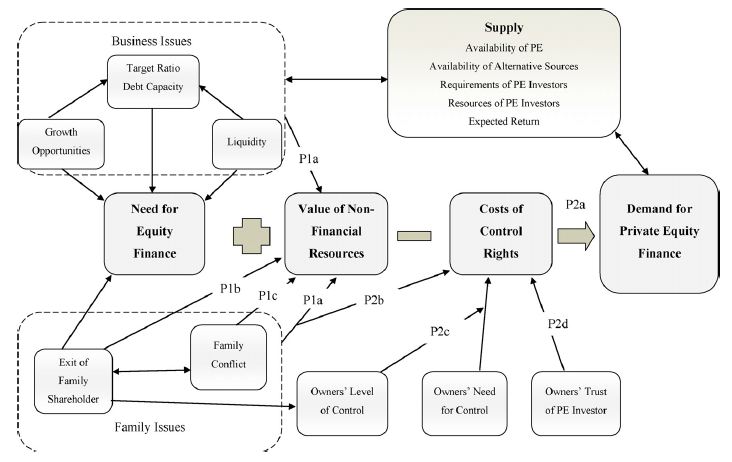
Most family owned businesses survive through the ingenuity, hard work, and resourcefulness of the founder(s) in the first generation. As the founders grow older and the business hits certain barriers to growth, often there is a need for a capital infusion to satisfy the goals of the founders and the other stakeholders in the continued growth and success of the business. Private equity, while a viable option for many privately owned businesses, can be perceived as a solution that is unworkable for the typical family owned business because of the fear of loss of control. In an article last year in the Journal of Family Business Strategy (Volume 3, Issue 1, Pages 38-51, March, 2012), authors Florian Tappeiner, Carole Howorth, Ann-Kristin Achleitner, and Stephanie Schraml describe some research they performed on a group of family firms in Germany. The research focused on issues these firms faced in soliciting private equity investment. Excerpts are provided below, along with a diagram, and accompanied by some commentary:

Under the pecking order hypothesis, private equity is a finance of last resort. Tests of the pecking order and its assumptions have provided conflicting results. For family firms, the pecking order hypothesis is incomplete because it ignores family effects. Case studies of 21 large family firms in Germany are analysed. Testable propositions are derived. Family firm owners balanced financial and non-financial resources of private equity with the need to cede control rights. Non-financial resources were valued more highly when resolving family issues. The observed pecking order was driven by control rights. Important implications for family firms and investors are discussed.

The authors articulate that private equity is perceived as a final option for owners of family businesses. No surprise there. Control is seen as the most important factor in determining what outside resources to enlist. Private equity is seen as less widely used than non-financial resources when the goal is to resolve family issues.

Family and business influences are equally important in terms of the demand for private equity in large family owned firms. Private equity was sought out for reasons that included the exit of a sibling, parents’ wealth diversification and business growth. The authors note an “interdependence of demand and supply in financing decisions, most noticeably in the negotiation of control rights, which featured strongly in the interviews. (Sometimes the underpinning reason for seeking an investor was to consolidate control, for example, buying out a family member with conflicting views or concentrating ownership in one branch of the family, which, it was argued, would free up decision making within the family firms.)”PE Finance in Family Firms

Minority private equity investments provided study participants with needed finance while allowing the family owners to maintain family control. Private equity also provides managerial resources. The presence of outside money and potential ensuing leverage in executive decision making illustrates the potential for better corporate governance practices and enhanced expertise to pursue business opportunities, such as IPOs or globalization. Said the authors, “Firms with family issues may value the non-financial resources that private equity investors may provide. In particular, family firms wishing to reduce family conflicts may value the neutral or professional role of a private equity investor.”

It was noted that business performance issues led to loss of control in two of the family firms receiving private equity infusions. Still others negotiated control rights guidelines aggressively because of their concerns over the potential of such an occurrence. The investors, for their part, acknowledged that dealing with family firms presented a unique set of challenges usually not experienced in other deals.

Overcoming Business Failures With Mentoring


According to Bill Warner, co-founder of EntreDot, approximately 26,000 new companies are formed each year in North Carolina and, in that same year, over 23,000 companies fail due to poor management and operational mistakes. Warner further states that, “The statistics are worse in rural and minority populations. This means that good ideas go to waste along with the grant and investor funds that helped get these companies started. As a result, the potential growth of revenue and new jobs is lost also.” These comments are very similar sentiments to what Dun and Bradstreet found in some surveys conducted during the period of 2007 – 2010. D&B found that the rate of business failure went up by an average of 40% during the recession years.

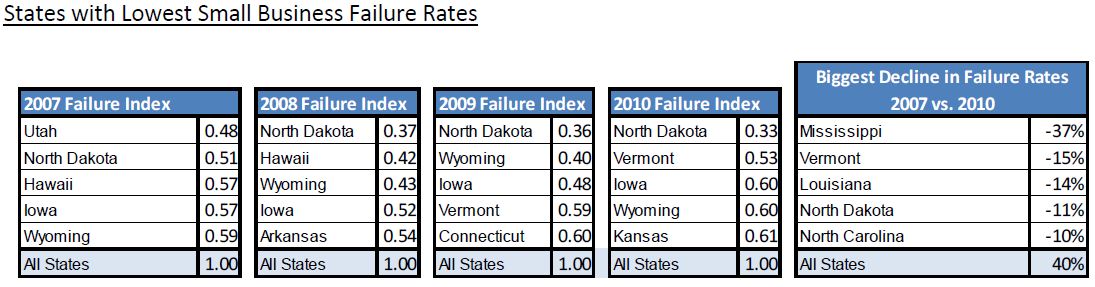
D&B SMB Lowest Failure Rate by State 2010


Many of the states with lower failure rate increases are less heavily populated states. In fact, of all the states that have seen a decline in the rate of small to medium sized business failure, only North Carolina makes the list of 10 most populous states in the country. Of states (below) with large increases in failure rates, only California is heavily populated.  

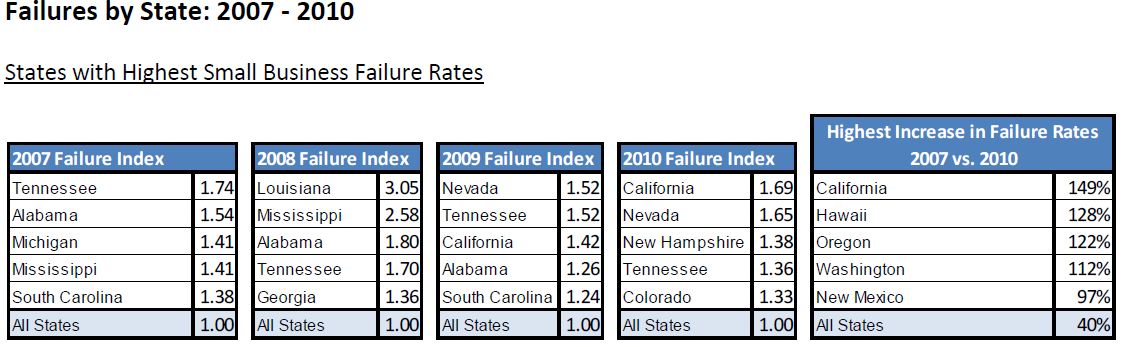
D&B SMB Failure Rate by State 2010


From 2007 through 2010, Western states in the West had the highest increase in failure rates. Reasons D&B provided for the uptick in failures include continued instability in the residential housing market and drop-off in the tourism, travel and hospitality sectors. Interestingly, Tennessee has been home to the highest small business failure rates for four years in a row.  

D&B Largest SMB Industries 2010


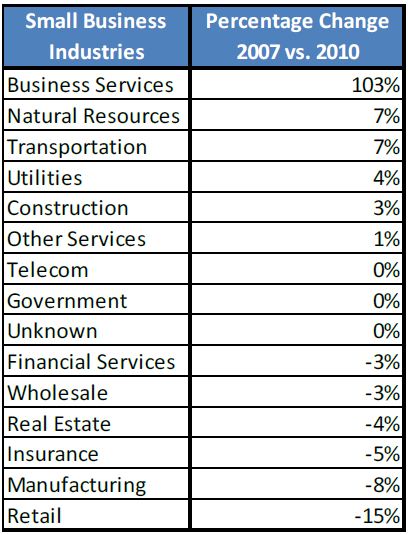
These trends have been occurring at a time when the number of retail establishments and corresponding retail employment have both dropped by 15-20%. On the other hand, the number of SMBs in the Business Services category more than doubled and these businesses experienced a 30% increase in the number of people they employ. The fastest growing industries for SMBs are summarized below:

D&B Fastest Growing Industries 2010


As you can plainly see, nothing else comes close to the growth of  the Business Services category. Bear in mind that many software as a service companies are part of this category and have been launched in only recent years. The macrotrends that become evident are that retail is on the wane, highly populated states are more stable in terms of business failure statistics, and the business services category’s growth will be a key cog in the engine of our economy.

Warner points to the following issues of significance to these small businesses:

  • Business strategy and planning to make sure their business is focused on a viable market with a winning product and/or service that has a competitive edge
  • Forecasting and financing ensuring that sales forecasts are realistic and that revenue, cost, expense and cash are well managed
  • Operational discipline and judgment to increase the chances of success by making fewer mistakes
  • Industry connections that can help accelerate the business and its operations
  • Start-up company experience that can instill the wisdom of what it takes to really start and manage an emerging business


He feels that these companies need the dual combination of basic business know-how and mentoring. The situation in North Carolina, where Warner and I live, is that our state has a comprehensive array of entrepreneurship education programs throughout the community college and university systems including various other private and public organizations. The problem is that we have little help for entrepreneurs once they have completed these programs and actually try to start a business. We recommend assistance for entrepreneurs who are struggling to create successful businesses, the failures should decline considerably. Entrepreneurs should be seeking out business mentors that can help them through the early years of their business.


Get Emails Read – Follow 7 Guidelines

Most businesses rely on emails for the majority of their communications. Yet, most of us are certain that some of our emails are ignored by the recipient. If you are trying to get your emails read, consider the below guidelines offered by Jonathan Borge of ToutApp. (Borge was contacted by Tom Searcy for a recent article for Inc.com on the subject.)

1. Subject lines: Remember that only 20 percent to 40 percent of your emails will actually get opened, though most of your subject lines will be seen. To boost your open rates, think of short, catchy, and informative subject lines. You should try to dangle compelling information (“The future of sales emails”), and you can even try adding some mystery (“Strange question”). We also recommend personalized subject lines, if possible (“Hunter Sullivan suggested I contact you”).]

2. Your tone: Portray yourself as someone that other people can connect to. You’ll want to show your recipients that you care about hearing back from them… so you can’t simply sound like you’re just sending another mass email. Never use “Dear sir or Madam,” and stay away from overly formal language.

3. Email content: Make your emails short, simple, and easy to quickly digest. Your leads are busy people with jobs, too, so you need to maintain their interest. Do your research and find out what resonates for your prospects. Try to get an introduction to them or, if that’s not possible, figure out in more detail what they or their company do. Tell them why you’re emailing them, specifically. Talk about how you can solve a problem for them.

Email

4. Your sign-off: End your emails with a definitive, clear call to action. Make it dead simple for your recipients to say yes—whether it’s to a meeting, phone call, or product demo. Don’t ask them for permission. If you want a phone call, then say “Call me right now at X for more details.”

5. Your timing: Reach out to your leads when they’re not too busy. Make sure you avoid heavy traffic times like Monday mornings. Based on our tracking data, we recommend the middle of the week, mid-day, as the best time to send emails.

6. Your image: First impressions are important both in person and online. The tone and formatting of your email is all your recipients have to judge you by. Make sure you are being professional, clear, and easy to understand. Stay away from over-formatted emails that look gimmicky, but don’t hesitate to call out important information in bold or bullet points.

7. Your homework: Send yourself a sales email. Put yourself in your leads’ shoes. If you were them, would you open this email? Would you spend more than two seconds reading it? If so, what would you do next?

Searcy notes that the list sounds almost too basic. Yet, when he went back and examined the last 10 recent emails he had sent to prospects and clients, he found that he only employed four of these guidelines on average per email. Why don’t you take the same challenge? Hopefully, you can learn from it –as he and I have!