Tremendous Entrepreneurial Success From Reading


Charlie “Tremendous” Jones, who is well-known in the insurance industry as a motivational speaker, believes in helping people improve themselves. His conviction for years has been that one must take responsibility for their own success. The quote below illustrates how he thinks one can best accomplish success in life:

You are the same today you’ll be in five years except for two things: the people you meet and the books you read. In every turning point and crisis of my life, there’s always been a book that helped me think and see more clearly and keep laughing and keep looking up and keep my mouth shut. I would never tell anybody I ever had a problem, so everybody always thought I was on top of the world, and yet I was just like everybody else with problems coming out of my ears. Now, when people come to my office, they come to talk to me. Instead of conversing with me like they think they are going to do, I get them reading. I pick out some great books and have each person read three or four sentences. I just received another email from a person recounting how his life was changed by learning the power of reading together–rather than talking.

As you may have read in a previous blog or Twitter post, I follow Under30CEO.com. Matt Wilson, one of the co-founders, posted on the Under 30 blog today some insights he gained from reading books this year. A few excerpts are provided below, with Wilson’s comments.

  1. Who’s Got Your Back by Keith Ferrazzi  – Relationships should be about quality over quantity.  The goal should not be to “know everyone”.  Build a small group of people that want to go out and conquer the world together.
  2. Boomerang by Michael Lewis – Base your economy, your company, and your income on creating real value for others.
  3. Small Loans Big Dreams by Alex Counts – Entrepreneurship knows no borders or social classes.  Coupled with education and accountability, access to capital can create sustainable micro-businesses.
  4. 48 Laws of Power by Robert Greene – “Disdain things you cannot have: Ignoring them is the best revenge.”
  5. Startup Nation by Dan Senor and Saul Singer –  “Immigrants are not averse to start from scratch. They are by definition risk-takers. A nation of immigrants is a nation of entrepreneurs.”
  6. The Education of Millionaires by Michael Ellsberg – “The biggest thing you won’t learn in college is how to succeed professionally.”
  7. Start Something That Matters by Blake Mycoskie –  It is truly possible to build a business both rich in profit and in social good.
  8. The Greatest Salesman In the World by Og Mandino –  “You were not created for a life of idleness.”
  9. Iceland, India, Interstate by Colin Wright – Go out there and LIVE.  Life is short, take advantage of it, and when you get a crazy idea–go for it.
  10. The Art of Non-Conformity by Chris Guillebeau – “If something is worth doing, you might as well do it all the way–so I’ve added ‘radical goalsetting’ to my own unconventional life planning.”
  11. Delivering Happiness by Tony Hsieh – There will never be another 2013.  When Tony sold his first venture to Microsoft, he said there would never be another 1999, and went to work on his next act, passing up millions of guaranteed dollars if he had simply stayed with the company and let his shares vest… All to chase his passion.
  12. The 4 Hour Chef by Tim Ferriss – Whatever you want to do in life, think about how to hack the system, so you can compete with only the best.

Matt’s list was 17 items long. Since there are 12 months in the year, I condensed it to 12 books and corresponding lessons to be learned and applied. Hope you find a nugget to help now and a book to read later. May you be better in five years for having applied yourself to reading!
 

Crank Up Content Marketing For 2013

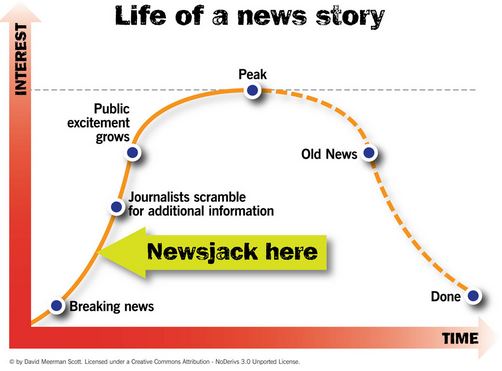
One of the leading developments in marketing has been the increased importance of content management strategies. With the proliferation of communication via the internet, companies of all sizes who are serious about engaging their target audience are looking to content as a significant tool. Clare McDermott, writing for the Content Marketing Institute today, took the opportunity to speak to to Amanda Nelson recently about how her organization creates content that is compelling, fresh, and engaging. Amanda manages content for Salesforce’s Marketing Cloud platform. Her job is to create and curate content for the Salesforce Marketing Cloud community. She manages everything from the blog and eBooks to webinars and infographics — with the help of a content team, of course.Newsjacking

Excerpts from Clare’s interview with Amanda appear below:

CMI: What issue do you think your content solves for your audience?

Amanda: Businesses want to become social, but they don’t always know where to start. What we do is create content to educate these organizations in the hope that when they are ready for social media monitoring, engagement, or publishing software, they will think of us. 

What kinds of content tactics are you using?

What we do is develop a content engine. A content engine starts with a central focus. In our case, it’s an eBook, but it could be a case study or any other piece of content that a company might have. From there, we publish the content by recycling and reusing it on multiple media:

  • We’ll read the eBook aloud and make it an audio book.
  • We’ll interview the customer for a quote in the eBook and then put that up as a video.
  • We’ll take the audio from the video and make a podcast.
  • We’ll create a presentation from the eBook with highlights.

What results have you gotten since you started using the “content engine”?

We’ve  had significant increases — about a 300 percent year-over-year increase in our eBook shares and downloads. I believe social shares of our blog posts increased by about 150 percent. What challenges have you run into?

A lot of people want to plan and curate, but at the end of the day, we need writers.. I sometimes have a need for (outside) writers..I’ll go out to the community and get guest bloggers. 

What’s your favorite tool used to communicate with the team?

We use Google Hangout because we’re actually all spread out across the country and Canada.. it is great because it’s video and it can hold up to 10 people. There are also fun things that you can do. You can do screen share or overlay funny faces. Whoever is talking is displayed predominately so it constantly changes. It’s in real-time, easy to use and free. The hangout is public so anyone else can join. People can see that you’re hanging out. It’s very social.

What are the most exciting examples of content marketing that you’ve see outside of your own business?

“News-jacking:” you see what’s going on in the media and they’re able to create content around it that becomes really shareable because it’s sitting where it’s hot. 

As you read through Amanda’s comments, take note of what she has done (with plenty of resources including a team of people) and think through how to interpret it and implement similar concepts in your business. We suggest the following:

  1. Think through your audience, where they hang out, and what your main message to each segment may be.
  2. Create a content engine that is your prescribed way of being consistent.
  3. Think about ways to use free, crowdsourced help for additional content.
  4. Investigate Google Hangout as a tool for enhanced collaboration.
  5. News-jack something interesting to supplement your original content. (Like we just did with this excerpt!)


Changes in Marketing You Need to Know For 2013

In advising my clients on marketing and related business development issues, it is often difficult to get them focused on integrated marketing approaches. Many have been sold marketing services by an agency that is not necessarily coordinated with either the overall business strategy or other marketing strategies and tactics. With the advent of a new year come a series of questions regarding the future and direction of marketing given the increased importance of the internet. Recently, Uri Bar-Joseph, director of marketing at Optify, in a blog post on the Marketing Profs website, addressed what his firm sees as trends in marketing for 2013. His opinions are offered below:

Digital-Marketing-Picture

1. Digital marketing will continue to grow

It’s pretty obvious to just about everyone that digital marketing is becoming the main channel for demand generation. But despite the adoption levels of digital marketing, there’s still a lot more upside. In 2013, digital marketing will continue to see huge adoption rates as businesses of all sizes implement all manner of digital marketing tactics.

2. Digital marketing services will surge

Subsequent to digital marketing’s mass adoption, adoptions, digital marketing services will spike. Consultants, agencies, and new services will surge to support new users and meet their demand for assistance.

3. Content creation services and software will proliferate

Content marketing is becoming the core of just about every marketing initiative for B2B marketing as well as B2C. In 2013, we will see a host of software and services solutions for content creation and syndication emerge as companies try to use content for more demand- and lead-generation results.

4. Integrated marketing will gain popularity

After new channels stabilize as standalone, consistent lead-gen options (social media, content marketing) and new channels and tactics emerge with enormous promise (mobile, re-targeting), 2013 will become the year of integrated marketing campaigns. Marketers will try to combine tactics to make use of the compounded effect of multiple channels’ working in unison. The market will react as more solutions will come to offer the ability to manage and measure integrated campaigns in one place, marking a decline in the adoption of one-dimensional solutions.

5. Direct mail will make a return

While digital marketing rises, sophisticated marketers will recognize the potential of direct mail coupled with an online connection to break through the noise. Solutions and services that offer integrated—offline and online—approaches will emerge and gain traction as a result of being affordable and highly measurable.

6. Big Data applications will emerge

Big Data has been the hot topic in the media for the last 18 months, and big companies such as HP, IBM, Microsoft, and other software conglomerates have been developing solutions to tackle Big Data. In 2013, we will see solutions emerge and adopted that offer big data applications for day-to-day marketing campaigns.

7. The immeasurable will become measurable

In 2012, we noticed a lot of talk about measurement and the ability to justify marketing efforts. As ROI becomes essential to the broad adoption of any marketing tactic, in 2013 solutions and services will find ways to measure previously immeasurable tactics and evaluate their contribution to the bottom line.

8. PPC will decline as budgets move to other paid solutions

In 2012 we’ve seen the first signs of decline in PPC usage for B2B companies. In the next year, more budgets will move away from PPC to new and more affordable channels and tactics.

9. Marketing spend on software will increase

As more software and infrastructure for marketing is required, Marketing’s budget will match IT’s.

10. Sales responsibilities will move to Marketing

The expansion of lead generation responsibilities in B2B marketing is resulting in the moving of more sales-related tasks to Marketing. In 2013 we will see marketing teams take over more sales tasks, such as lead qualification, inside sales team management, and sales operations.

How about you and your company? As you think about your strategy for business growth for 2013, which of these trends have you thought about? For me, the top 3 things I want my clients to focus on are integrated marketing, metrics, and a digital marketing (including content) strategy.


Reliquary, Hajj, or Commons – Choose to Engage

In analyzing the entrepreneurial contribution of artisans, we scratched the surface of an underlying question as to what constitutes the arts business. Some would argue that there is a defined business model that has worked for many artists and artisans for decades and that newcomers should kowtow to the tradition. Others proffer that art is not to be seen as a profit making enterprise, but as creating an aesthetic that serves the individual and/or community psyche.

Doug Borwick, immediate past President of the Board of the Association of Arts Administration Educators, queries in his blog over the weekend whether art is an ….

Individual or Community Resource?
A good (and valuable) preliminary question might be “Are the arts an individual or a community resource?” Trick question, of course. The arts inevitably serve both. However, I think much of our focus is on the individual, both as creator and consumer. I certainly believe more attention should be paid to the arts as a resource for community improvement. And, of course, by community I mean any collection of people who are bound–intentionally or, sometimes, de facto–by a characteristic they share: geography, certainly, but also culture, interests, concerns, preferences, background, etc. We speculate that this service to community was one of the origins of the arts but their binding or healing power for communities has been, in my opinion, under-appreciated, under-valued, and under-utilized by the arts infrastructure. 

He then suggests that the community service contribution of the arts has not been valued and monetized properly. The definition of community is interesting–in addition to geography, he references culture, interests, concerns, preferences, background, ans other contributing factors. In admitting what artists and artisans focus on the individual as creator and consumer, it is unspoken that the creative individual understands the consumer’s needs. In my own experience with friends and family members who are highly creative, as well as artisans who participate in a boutique/incubator I advise in Raleigh, NC, I am stunned that very little thought appears to be given to buyer personas. 

Buyer personas are what helps the entrepreneur figure out what may sell. Knowing as much as possible about the thoughts and values of your target buyer gives you the best opportunity to tailor your works for sale. While I understand that consumer sales are not the motivation of the typical creative, it does factor into the computation of how not to be a starving artist. There is also room to create works for the cultural enrichment of the community if, as Borwick points out, one can find a way to monetize it. In fact, Borwick uses a series of metaphors to try and explain the business of art:reliquary

Reliquary, as in a shrine or container of relics. The only focus here is on the relic. A reliquary would still be a reliquary if no one looked at it. Arts organizations that are “all about the art” are reliquaries whether they deal in visual (fixed) or performing (variable) work.

Hajj, as in a regularly occurring pilgrimage to a holy place.. A pilgrim is required for a hajj, but the intent is for the participants to be uplifted by objects or experiences. In the arts hajj, it is the audience/visitor who is transformed or edified; the art is fixed and not altered or affected by external concerns, interests, or influences. 

Commons, as in a resource accessible to all members of society. The commons belongs to everyone, even those who do not take advantage of it. .. if a work of art is not speaking to the community, that’s not the community’s fault; their response is either community-focused education or selection of alternative works.

Think through these metaphors in your own creative journey. While you may not consciously think you are creating shrines or a “city on a hill,” the question remains whether the community for whom you claim to create appreciates your work. If not, back to the proverbial drawing board to  rethink the buyer persona for something that resonates more powerfully!


Ingenuity Expressed in Art(isan) Entrepreneurship

John Bogle, founder of Vanguard mutual funds, attended Princeton University and was fascinated with entrepreneurship. In his senior thesis in 2006, he cites Joseph Schumpeter as the first economist to recognize how start-ups are so vital to the national economy. Schumpeter was understood to advocate for the fact that entrepreneurs are motivated by the following two characteristics (more so than materialism):

  1. “The joy of creating, of getting things done, of simply exercising one’s energy and ingenuity,”  and
  2. “The will to conquer: the impulse to fight,…to succeed for the sake, not of the fruits of success, but of success itself.”

Certainly, these characteristics are resonators for many entrepreneurs; perhaps most especially so for art(isan) ones. What? Art(isan) entrepreneurs? What is meant by this juxtaposition of terms? Heretofore, many have considered the creative types to be an island unto themselves, rather that a subset of he entrepreneurial movement that is sweeping our land. Yet, if we were to characterize creative types as right brain entrepreneurs and those who pursue STEM education, career opportunities, and new enterprises as left brain, we can create a new construct that is helpful to understand how to encourage the greater number of people to flourish in what is generally regarded as the Creative Age, successor to the Information Age.

Creative thought processes may be said to represent divergent thinking at its essence–the ability to hold an idea without passing judgment of any type. Systematic and analytical processes, therefore, tend towards convergent thinking-a deliberate effort to arrive at a conclusion based on facts and data. In the Research Triangle Park area of North Carolina, we are seeing nothing short of an epic surge of entrepreneurial fervor, much of it trumpeted as helping our economy–both local and beyond–to improve through enhanced job creation, capital flow, and value creation. Yet, virtually all of the media attention is on savvy technology start-ups that seem to rely almost exclusively on the left brain mindset.

Thankfully, there are overlaps such as the digital art required for serious gaming that brings the two sides of the brain together. Outside of such obvious blends of thinking modes, most who inhabit the incubators, accelerators, and entrepreneurial playgrounds of our region are tuned out as to how art(isan) talent can establish entrepreneurial enterprises. 

The art(isan) population has been challenged to find itself, both locally and nationally, as economic recession has caused many galleries, academies, and the like to cut back on programs, space, and staff. Those who have graduated with degrees in various creative fields from design to fashion, studio arts to music, have found employment hard to come by. In times past, many graduates became instructors in the arts or pursued employment in businesses that served entertainment venues. In order for the creative class to find optimal professional engagement, however, new ways will need to be discovered to help art(isan) entrepreneurs convert their passions into their professions. Like a hero on a journey (think of epics like The Odyssey), artists and artisans must set out to manifest her ideals in her creation. 

Creative types do not need skills training from career development types in order to become successful (and more readily accepted) entrepreneurs. What they need is to find people who appreciate their contributions. Just as indie music has shown huge demand for music that is not recorded in an album format, carried on mainstream radio, and performed in huge concert venues, there exist niches for virtually every type of created expression if the artist/artisan will labor to identify the target market. 

The opportunity to showcase one’s talent in a coffee shop, a multi-artisan boutique, or a street show are all vital to artisan entrepreneurship. By inviting others to experience one’s proof of concept, feedback can be gleaned that shapes the creative offerings going forward. Once enough traction is gained within a target market, the artisan can make decisions about what part of the production and delivery of talent she wants to play without fear of being unable to earn a living just as powerfully as any other entrepreneur.

Artisan holiday support