Wanna Start an Entrepreneur (Political) Party?

In an article for Entrepreneur Country’s November issue, Joe Haslam critiques the last year’s election cycle in Spain. Similar to what we experienced in the United States, top candidates for the highest office in the land lauded the importance of small business. In like manner, candidates spoke highly of the value of entrepreneurship and pursuing a dream to start a business. In Spain, the Conservative Partido Popular claimed to be in sync with the perspective that high growth startups create jobs and fuel the economy on both a local and national level. Our candidates voiced similar opinions. Akin to our own situation, the conservatives claimed that the establishment was too focused on taxation and government spending to be able to encourage the right kind of economic growth.

The Partido Popular proposed (if elected) to introduce within its first 100 days in office and Entrepreneur Act meant to encourage and support the establishment of more new businesses. Issues like limited liability and zones for new business creation would be included in the legislation. Open discussions between successful entrepreneurs and the Partido Popular team charged with creating its platform were held to tackle the business registration process and the need to enforce competitive fairness procedures. Unlike the United States, this party won (but they have failed within the past twelve months to deliver what they promised.)

Instead of the press attacking the government for failing to deliver on campaign promises, it seems to make excuses ranging from the need to defend political appointments to challenges in addressing new issues that have emerged since the election. Since the Entrepreneur Act has not only not been passed, but officials now say it may be 2014, many–including Haslam–who have investments in the entrepreneurial market in Spain–have become disheartened. They no longer try to persuade talented young creative talent to stay rather than seek their fortunes in emerging markets such as Brazil, Korea, Mexico or India. 

Within the sunny setting of Santa Monica, California, there exists the home office of the Entrepreneurship Party. Not to be outdone, the Ukraine boasts its own Party of the Industrialists and Entrepreneurs. Haslam wonders aloud whether a third party focused on issues that matter to entrepreneurs and small business owners would be a better alternative than encouraging the constituents to join existing parties who have such crowded agendas that entrepreneurship is just another plank in the platform. He also draws an important distinction between business people who have only worked for big businesses and those who have grown their own enterprise organically, from the ground up. The latter group seems to have the highest likelihood of being able to be empathetic to the issues that matter, as evidenced by people like Michael Bloomberg. Bloomberg  made an appearance at a TechCrunch Disrupt event to hype the new Entrepreneurial Fund in New York.

In some Western countries, politicians have followed a path of making money in the private sector prior to entering into public service. Contrastingly, an Economist article is cited claiming that many in Eastern countries see politics as the way to make the most money  fastest, and a pattern or nepotism is only recently being challenged by outsiders. In the end, it is suggested that entrepreneurs may be able to make the most difference by tackling specific issues, whether you are looking at Bill Gates’ second career as a philanthropist and the great work he is doing through his foundation, or the chairman of Zappos tackling an array of issues in Brazil through private sector initiatives.

Yet, it would be fun to see an Entrepreneur Party and how many votes it could garner, wouldn’t it? Would you just be a social media follower of such a party, or an activist?


5 Ways Creativity Training Accelerates Innovation

“Creativity and innovation training is a highly effective accelerant for business results.”

-Gregg Fraley

Contrary to naysayers’ beliefs, creativity is a skill set for which training can be developed, delivered, and deployed.  In fact, brainstorming is enhanced by training! Those who tout research saying that brainstorming is ineffective are usually quoting studies that were conducted in situations wherein no training was provided in advance.

Another fallacy that people latch onto is the thought that some people are innovative and others are not. Inside larger companies that tend towards bureaucracy and group think, it can be hard to jump start creativity and innovation. Yet, most will acknowledge that analysis sans insight has severe limitations. Fraley advocates for the principle that training can make a big difference in bridging the gap between market knowledge and potential.


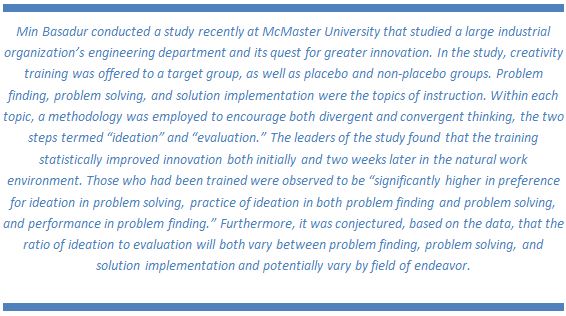
As you can see from the study, creativity training (when done well) can be instructive for employees who need to learn how to think and express ideas in a more positive, focused, and spontaneous way. Breakthrough results often occur when properly fueled by a rapid, flexible, and structured process at the front end of innovation.

Most R&D or innovation initiatives include no budget for training. Since creativity can aid with problem solving and problem finding, organizations need to be awakened to the potential missed from failure to pre-train.  Fraley feels  creativity and innovation training accelerates innovation in five strategic ways:

  1. Improved creative thinking leads to enhanced innovation capacity, and with action, results.
  2. Training helps instill structured creative thinking and innovation process as a cultural value and habit.
  3. Training provides innovation teams with a common language and framework to solve problems, improve communication, expedite complex problem resolution, and moving new business concepts forward.
  4. Training corrects many of the myths that surround creativity and innovation. There is a science to this that is largely ignored. For those that learn and practice the science — it’s a competitive advantage.
  5. Team efficiency improves because a lot of useless chatter, debate, and conflict are eliminated.

Creativity is intimately related to change, decision making, and problem solving — it’s not just artistic self-expression!


Can Generalists Thrive in the Conceptual Age?

One of the questions I get most often is: “what do you do?” The answer to that question is not an easy one, as my work with companies ranges from start-ups to those almost middle market size, and the services I offer from advisory board member to turnaround artist. Yet, when my role is marketing consultant, I advise others to be able to answer the very same question crisply, concisely, and in a compelling way. What is poignant is that, as we gain more skills over the years, it becomes harder and harder to specialize. That is not to say, however, that I have not met people in business who are extremely specialized and who succeed in their field. For the moment, though, I want to write for others who have adapted to competitive market demands to embrace new skill sets, become masterful enough that others hire them to provide those new skills, and now are the proverbial “generalists.”

Don’t confuse “generalist” with “General,” however, as many generalists struggle to stay with one organization long enough to rise to the rank of top officer. Furthermore, a generalist has challenges in the unique realm of trying to keep up with evolution in many more topical areas, all of which are changing at a faster rate than at perhaps any time in history. The good news is that, as Daniel Pink points out in A Whole New Mind, we are now living in the Conceptual Age, having evolved from the Information Age to a day and time when creativity will be valued highly. Maybe that is not such good news for left brain folks who are not able to adapt, but for those (for whom the learning of new information was merely a means to an end, the end being to connect emotionally with others, build relationships, and find success while doing so) who embrace right-brained living, it is a brand new day!

Here are the new skills that are needed in the Conceptual Age:

  1. Design – the ability to create something that has significance as well as usefulness.
  2. Story – the ability to put facts into context and deliver them with emotional impact.
  3. Symphony – the ability to see the big picture, connect the dots, combine disparate things into something new.
  4. Play – sense of humor and laughter plus other components to balance the psyche.
  5. Empathy – standing in someone else’s shoes, feeling with his or her heart, seeing with his or her eyes.
  6. Meaning – working for something in which one believes with others who have similar values.

As you can see from the list, the emphasis and value will be placed on original thought rather than automatable routines. Computer power has now rendered many repeatable acts less valuable (not unnecessary, mind you, just worth less than previously because either low wage earners or machines can perform them admirably). What will come to be increasingly important is the ability to think up a new concept, develop it sufficiently, and share it so that it resonates with the heart of another. 

What’s the role of the generalist in this new economy? That depends–can you adapt, or are you trying to pour new wine into an old wineskin? Those of us who can adapt will be able to answer questions like “what do you do?” with less of an elevator pitch and more of a carefully crafted story that captures the mind, will, and emotions of the intended audience, hopefully in a multi-sensory way!

Cheers to you as you embark on the journey to greater relevance, enhanced value to others, and — I sincerely hope — a much greater sense of doing something truly meaningful (other than just adding to your repository of information.)


What Medium Do You Choose to Publish?

This week marked the announcement of Medium, the newest offering of Evan Williams and Biz Stone. These are the two “rock star” entrepreneurs who successfully created Blogger and Twitter. What they are trying to do with their newest venture is to redefine how and why content is published on the web.

In his first blog post about the new concept, Williams says Medium represents only “a sliver” of what he and his team have learned about publishing and the need for innovation. Blogger pioneered the premise that one could publish for free whenever and wherever desirable and create a reading audience. While the effort was revolutionary at the time, it has become commonplace as other substitutes and competitors have pursued the same target market. To “up the ante,” Williams thinks that collaboration and quality content that is crowdsourced are the new frontier:

“Lots of services have successfully lowered the bar for sharing information, but there’s been less progress toward raising the quality of what’s produced. While it’s great that you can be a one-person media company, it’d be even better if there were more ways you could work with others.”

Pinterest postures as a collaboration platform where favorite objects (mainly photos) from the Web can be saved and shared. Crowdsourcing quality content through reader votes is done in differing ways by Digg, Reddit, and Tumblr. Of these, Tumblr is the best of the bunch for publishing and sharing content. In the dual realm of curation and instant publishing RebelMouse, uses social-networking activity to create a curated page of content that can be organized by preference, and Svbtle is a simplified blog platform with a stripped-down design.

Matthew Ingram, writing for GigaOm, observes that “both of the things Evan Williams is famous for also looked either unnecessary or unimpressive, and in some cases both. Blogger was cool if you were a geek and wanted your own website, but it was far from obvious at the time that self-publishing was going to become something huge or crack open the media industry in a fundamental way. And Twitter looked so ephemeral (not to mention the ridiculous name) that many people dismissed it as a plaything for nerds that would never amount to anything. So as Aaron Levie of Box.net noted on Twitter, it doesn’t pay to underestimate Williams when it comes to this kind of thing.”

Ingram says that Medium looks like a combo of Pinterest & Tumblr, though not proficient at text contributions. Furthermore, he references Josh Benton of the Nieman Journalism Lab as saying that Medium subverts the notion of the author as the most important thing about the content. Medium is focused more on the value of the content, regardless of who is producing it or voting on it. Instead of a blog or collection showing whatever is the newest thing — the typical reverse-chronological format used by most blogs and publishing platforms — Medium sorts according to popularity (similar to Digg.) does (in a similar way, tools like Prismatic sort items based in part on the social activity around that content).

The social media culture demands more from publishing; BuzzFeed and the recently-launched Branch (also incubated by Obvious Corp.) are trying to become viable, popular solutions. Time will tell whether Medium is better than anything else out there. As Levie put it, don’t bet against it!


Real Estate Agents Must Understand Content Management

Today was a good day. In addition to meeting with some smart minds about artisan entrepreneurship, I had the opportunity to plan a pitch event for would-be entrepreneurs and meet with an existing business owner who desires to invigorate his enterprise. His business is real estate–specifically residential sales. What he’s hoping to accomplish is to build a powerhouse brand that competes statistically with the leading agents in our community while targeting an under-served niche market. He asked me about my philosophy on how to accomplish his goal(s).

We began with a conversation about the role of social media in marketing services organizations. Fairly quickly, I felt the need to draw a diagram to make a key series of points. The figure below is what I drew for him–allow me to explain it to you so that you can be on the same page as we ended up:


Everyone knows that Social Media is on the rise and important to reach niche audiences in engaging conversations. What I was able to point out to this entrepreneur is that social media is a subset of Content Management Marketing. Knowing what messages you want to get across is a precursor to sharing the right information through online channels. To begin making posts, tweets, updates, etc without in-depth knowledge of target prospects and their needs is like wearing a blindfold in an archery contest.

Whether it is your strategy as an agent to build your business through referrals from prior clients, key centers of influence, or new campaigns, it is unwise to get spread too thin and not have deep relationships. Given the huge number of users on many social networks, the agent must devise a strategy that isolates niches and pursues them with targeted strategies.

The diagram shows that thought leadership is obtained by creating great content that is shared through social media. In response, the various media provide a built-in feedback loop that should drive future thought leadership strategies. For instance, some agents provide insights in multiple categories for their target audience(s). Whether it is local community, national real estate trends, the agent’s own interests, or local real estate content, the point is to demonstrate that you know what you are talking about.

Lead generation is the holy grail for many agencies that advise real estate firms. They think that, if they can generate enough new prospects for the agents to pursue. they have earned their keep. However, as the agent with whom I was meeting explained, leads that are not qualified and filtered can waste a lot of time. Smart lead generation comes from site visitor capture initiatives that are driven by a content management system that relies on social media to create online experiences for web fans.


Having worked in marketing roles for multiple services firms, I have met many peers who are entirely comfortable being creative, attending wine and cheese events, and spending the money of the business owner(s). What many of them lack are measurement systems (metrics) that validate the marketing ROI.  Furthermore, when metrics are available (web analytics come with every website), the marketers often don’t use the information to change the messaging and means of communication. Smart agents know better and use metrics to verify that what they are doing is working.

Competitive advantage is what is so hard to achieve, yet worth the pursuit. It is that unique place where the audience you target perceives that you can solve their needs “better” than any other provider. “Better” means that the home buyer/seller connects with the agent on a personal and professional basis and feels that the fee they pay to be represented is a value that exceeds what else is available to them.

What is your Content Management Strategy? Do you have one?