4 SmallBiz Keys to Success From Fieri

If you are a successful small business owner, chances are high that you didn’t get to that place without some setbacks. Rare is the one who never experiences setbacks–in business or life. However, in the sentiment of “turning lemons into lemonade,” it is important that we never allow the setbacks to keep us under. Guy Fieri of Food Network fame certainly has attained some notoriety. We love to watch his show Diners, Drive-ins, and Dives and have visited several of the restaurants featured on the show.
Guy has a certain flair about him–he of the big hair, fancy sports car, and distinctive gotee. Years ago, he and a friend, Steve Gruber, launched their successful food careers with Johnny Garlic’s, two California-style restaurants. The original location in Santa Rosa caught fire one night in 2001. Undeterred, the pair launched another restaurant in 2003, Tex Wasabi’s, which also developed a loyal following. A year later, Russell Ramsay’s Chop House replaced the first Johnny Garlic and the due felt they had come full circle. However, Russell Ramsay’s was slow to get off the ground. Tinkering with the menu and trying to woo former customers back were unsuccessful in helping turn things around.

Gwen Moran, writing for Entrepreneur, shares Guy’s journey:

…one day, Fieri was sitting at a traffic light, when a guy in the car next to him called over and asked, “Hey, why didn’t you reopen Johnny Garlic’s?” Fieri replied, “I did. It’s the Chop House.” His former customer said he couldn’t afford to eat at the Chop House, and he missed the original restaurant.

That was Fieri’s light-bulb moment. Customers wanted the familiar place they had grown to love. The Chop House gave off a too-rich-for-our-blood vibe—not a good fit for the eatery’s largely blue-collar following. Within a year, the Chop House closed and reopened Johnny Garlic’s, business was up 25 percent within the first month.

Moran says that Fieri learned four lessons from his experience:

1. Listen to feedback from your customers. If Fieri hadn’t paid attention to the guy who spoke to him at the red light, he might have continued trying to get customers to accept something they just didn’t want.

2. Understand your customers’ perception of your business. The Chop House menu wasn’t significantly more expensive than Johnny Garlic’s, but people thought it was. That’s what mattered — and what kept them away.

3. Check your ego at the door. Fieri could easily have let his track record as a successful restaurateur go to his head instead of admitting that the Chop House wasn’t the best fit. Really listen when you get feedback from customers and employees, he says. They’re telling you how you can be better.

4. Don’t give up on your dream. Find a way to make your dream work, even if you have to keep experimenting with new ideas and approaches until something sticks. “Surround yourself with good people who are dedicated and have good ideas, and can help you see what you’re missing. Don’t throw the baby out with the bath water [when times get tough],” he says.

These are four watchwords for any business owner. After we’ve been in business a while, it is so easy to forget what/who helped bring you to that point. Without competitive advantage, a business is not successful. Without customers, there can be no competitive advantage. Inattention to input and thoughts about your business leads to a lack of customers. A willingness to adapt to what the market needs is key to business success. Finally, as Fieri suggests, perseverance is the “glue” that holds it all together.


What Have You Overcome to Be Successful?

Entrepreneurs who don’t win business plan or pitch competitions often get down on themselves. They may wonder whether they will ever get the funding needed to turn their idea into a commercial venture. The sense of frustration when circumstances don’t appear to go the right way can lead to despondency.  Vivian Giang, writing for Business Insider in an article published earlier this week, reminds that others have overcome greater odds.

Giang shares Ryan Blair’s story of coming from a broken family, learning disorders, and gang life to become a multimillionaire serial entrepreneur. In his bookNothing to Lose, Everything to Gain,” Blair writes:

“I quickly saw how the system worked, how the street lords kept themselves in power through influence and manipulation. I observed how the older people used bribery and fear to get the younger kids to do their crimes, and I saw how the young people willingly went along with it because it seemed like the only power structure that had any kind of respect in the neighborhood.”

“Long before I became a millionaire entrepreneur, I was a kid with a criminal record, street gang experience, and a lot of emotional scarring from years of abuse from my father. My teenage years were hardly the typical starting point for a normal, productive life, let alone a successful business career. Turns out, that didn’t matter.”

Blair was arrested more than ten times. Living the street life left him facing a four year sentence and the tender age of 16. His mom began dating a businessman a couple years later who showed modeled how to make money legally. Giang observes that Blair was insightful when he decided to apply the survival skills learned on the street to make money the right way. His “street smarts,” she writes, were gained from observing the strengths of the gang system through a new lens.

“There’s a hierarchy in gangs, a hierarchy of positions and power,” he says. “A gang is an economic system, and there’s a lot of similarities between gangs and some legal companies. I know that it’s not always the most powerful organization that’s going to make it, it’s the one that’s most adaptable with the changing times, the one that understands how to manage their politics.”

At 21, Blair launched his first company (24/7 Tech) and brought his understanding of street economics, plus a determination to turn himself around, to bear on the effortToday, he’s the CEO of ViSalus and won the DSN Global Turn Around Award in 2010 when he actually turned the company around from being $6 million debt in early 2008 to sucess 16 months later.

When trying to get his first business off the ground, Blair says he was nervous about ‘taking his skeletons out of his closet,” because people were always “looking for a reason to see why they are better than you. People look at people who don’t have pedigree upbringings differently.” But “if you avoid it, or hide it, others might feel as though there’s a dishonesty there, and hiding something is a very expensive emotional thing for you.”

Blair’s belief that others, too, can overcome mistakes and troubled histories influences the way he runs his own company. He said that he’s willing to hire people with a criminal record–provided they are honest about the past in the present. It seems to be working well for him!

So, if you as an entrepreneur feel that you have long odds for success, consider what Blair and others have been through. He has faced similar challenges to your own–and additional ones that, thankfully, do not confront you. With that in mind, hopefully smaller challenges will be seen for what they are.


Founders Overdose on “Sweets”


How can too much of a good thing be very very bad in management? Imbalance, for one, is a perfect example of “overdosing” on what, in isolation, is innocuous. In the Research Triangle Park area of North Carolina, like the Bay area of California, or a certain part of Massachusetts, technology companies abound and the media is in love with the fruits of the labors of the company founders. Certainly, without the contribution of needed jobs, tax revenues, and similar benefits, the local economies in these regions would suffer. But, on a far more local level–that of the management of a team of people–there can be an inherent problem that is both insidious and solvable.

The concentration of too much emphasis on software development skills, for instance, to the exclusion of other needful disciplines can become a company’s undoing in an imperceptible yet profound way. We must acknowledge that, as human beings, we are most comfortable surrounding ourselves with others who think similarly to us, have homogeneous backgrounds, and understand what we’re trying to communicate  quickly. The danger, though, is one of management myopia. Without a team of executives who bring complementary viewpoints–that are different yet legitimate in their own right–it becomes easy to suffer from the group-think phenomenon like a bunch of lemmings.

Organizations that allow themselves to be managed by cookie cutter leaders are often blindsided by development that Porter’s Five Forces, a SWOT analysis, or common sense in the eyes of an outsider could have anticipated. Market shifts–whether in the realm of sales, finance, operations, or a myriad of other subsets–when realized too late can lead to a company’s fall into a type of death spiral. Turnaround practitioners far and wide have witnessed the phenomenon more times than they’d like to admit and cringe upon encountering it because they know it could have been avoided.

One of the great turnaround consultants I studied in performing research that led to the establishment of the Turnaround Management Association was Donald Bibeault. Bibeault wrote that, “A special case of imbalance in the top team–particularly at the board level–is a weak finance function. This may appear through the company as a general phenomenon, resulting in inadequate financial and accounting controls. But even when these systems are perfectly adequate, their message may not be heard at board level because the finance function is not strongly represented there.”

What should we make of such an observation, then, in our own companies? Firstly, that true outside boards of directors with balance can be a great asset to an organization. These veterans have “been there, done that!” Secondly, as one goes about building a team, become more self-aware of the temptation to populate the organization with a clique of robots, who while very intelligent in their domain, are ignorant on many other topics. Thirdly, consider the value of co-founders and mentors whose life experience is very different than one’s own–albeit they should have been successful in whatever they have previously pursued.

Don’t overdose on what is sweet–do what is nutritional for your organization!

Due Diligence Must Include Culture

60% of mergers, acquisitions, and joint ventures fail to perform up to expectations in their first year, often because of cultural incompatibilities between the two prospective partners. The losses in shareholder value are in the hundreds of millions of dollars in many of these star-crossed liaisons. Cultural Due Diligence is a technique for keeping both eyes wide open when approaching an attractive prospect, whether for a merger, joint venture, or offshore vendor.

-Wayne State University, Institute for Information Technology and Culture

When two companies agree to join forces in some type of agreement, cultural fit is usually the last factor considered-if at all! Instead, many numbers are crunched, recrunched, and analyzed ad nauseum. Market impact, anticipated back office savings, etc receive the lion’s share of the secondary consideration after financial statement items. “Culture” is perceived as too soft an issue to justify the time and attention of high-powered executives. Big mistake!

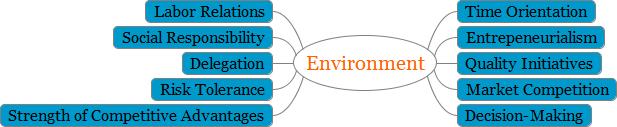
At the very minimum, the operating environment and organizational structure of each entity needs to be explored. When we are working with a client, we use the following two charts to help us ask solid questions about these two components of culture. From the answers received, we make value judgments and recommendations as to the degree of “fit” between organizations and what to do about it.

In considering the operating environment, we look at whether the company has a long-range or short-term approach to management. We ask questions to determine whether the organization is more entrepreneurial or bureaucratic. Quality initiatives are a good indicator of what aspects of performance are most important to management. The degree an strength of market competition for each party is important. How decisions are made is another leading indicator of what it may be like to work alongside the other team.

How management handles relationships with employees, (unions), and contractors is important to search out. Is giving back to the community and having respect for the environment a value of the other organization? Do meaningful tasks get delegated effectively, or are there barriers to professional development , shared responsibility, and growth through the contributions of many? Discovering how the other party perceives risk and builds strategy accordingly is a key conversation. When one’s competitive advantages are articulated, it is vital to verify how strong they are in the eyes of the buyers.

In addition to the operating environment, it is critical to understand the organizational structures that represent the philosophy of your intended. Do employees have direct access to top executives, or must they work through a layered management team? Understand whether the employees feel that they are protected to the point of not being allowed to make any mistakes. Examine whether generalist skills are valued versus everyone having a narrow scope. Look at the board of directors to see whether it is comprised of objective, strong leaders. Pay attention to the diversity of the employees and management team.

If the other company has a multi-office system, is it managed out of corporate, or are those in the field given autonomy? Notice whether task or relationships seem to carry more weight. Analyze the turnover rate among management and key positions. Is the human resources department deep enough to undertake complex issues like training and development, talent management, succession planning, coaching and the like, or compliance focused? Ask for examples of how technology is used to solve problems and enhance work flow.

The careful review of these “soft” factors can save you some headaches and hardships–do it! (We would love to help.)


American Restaurants Struggle to Stay Alive

Back in the late 1980s, the Turnaround Management Association was birthed out of a research project conducted at the Kenan Institute of Private Enterprise at the University of North Carolina at Chapel Hill. As the lead researcher, I had the opportunity to personally pull together a bibliography of articles about businesses whose travails were significant enough to hit the national headlines in various business publications. From the research, we published a monograph and wrote articles about best practices that appeared in 46 national business periodicals in our first 18 months of existence as a trade association. As I and other involved with the Association moved on to other pursuits, TMA moved off campus, starting gaining momentum in chapter development, and now enjoys international members as well as domestic. One of the publications of TMA is the Journal of Corporate Renewal. The Journal‘s lead article for May discusses the struggle of restaurants in the United States to remain profitable.

Some interesting facts from the National Restaurant Association are cited:

  • Restaurants account for 4% of GDP
  • 10% of the U.S. workforce is employed in the restaurant industry
  • 50% of adults have worked in a restaurant
  • one-third of all workers had their first job in a restaurant
  • 48% of the average household’s food budget goes to restaurants (vs. 25% fifty years ago)

The bankruptcy filings of a number of restaurant chains since the recession began in 2008 is but one indicator of a model that is teetering on the brink of survival. The photo above is taken from a Food Network show entitled Restaurant Impossible, wherein Robert Irvine turns a restaurant around in 48 hours. The menu is revised, customer service issues are addressed, $10,000 of strategic remodeling is performed, the revenue and costs are examined for opportunity, and the restaurant owner is challenged to run the business at a profit going forward.

Macro trends in the recent few years towards buying more groceries or becoming value-conscious have definitely affected the top and bottom lines of many restaurant owners. Franchises, which account for about half of the restaurant revenues produced nationwide, have really taken it on the chin. Franchisees who own one or only a few stores have inadequate access to capital these days. Another big factor is the conflict of interest in most franchise agreements that are based on sales volume. The franchisor can implement discounting programs to increase traffic and sales volume, but the franchisee has less and less profit as a result of the agreements.

What can be done? Turnaround experts recommend a process of performing store-level profitability analysis, followed by benchmarking against peer stores. These analyses can highlight purchasing/inventory issues, training issues that are evidenced by waste, and theft/shrinkage that depletes the operator’s assets needed to produce a return.

There are many good consultants who can help a restaurant owner sort through the challenges and create a plan for growth and renewal.