Founders Overdose on “Sweets”


How can too much of a good thing be very very bad in management? Imbalance, for one, is a perfect example of “overdosing” on what, in isolation, is innocuous. In the Research Triangle Park area of North Carolina, like the Bay area of California, or a certain part of Massachusetts, technology companies abound and the media is in love with the fruits of the labors of the company founders. Certainly, without the contribution of needed jobs, tax revenues, and similar benefits, the local economies in these regions would suffer. But, on a far more local level–that of the management of a team of people–there can be an inherent problem that is both insidious and solvable.

The concentration of too much emphasis on software development skills, for instance, to the exclusion of other needful disciplines can become a company’s undoing in an imperceptible yet profound way. We must acknowledge that, as human beings, we are most comfortable surrounding ourselves with others who think similarly to us, have homogeneous backgrounds, and understand what we’re trying to communicate  quickly. The danger, though, is one of management myopia. Without a team of executives who bring complementary viewpoints–that are different yet legitimate in their own right–it becomes easy to suffer from the group-think phenomenon like a bunch of lemmings.

Organizations that allow themselves to be managed by cookie cutter leaders are often blindsided by development that Porter’s Five Forces, a SWOT analysis, or common sense in the eyes of an outsider could have anticipated. Market shifts–whether in the realm of sales, finance, operations, or a myriad of other subsets–when realized too late can lead to a company’s fall into a type of death spiral. Turnaround practitioners far and wide have witnessed the phenomenon more times than they’d like to admit and cringe upon encountering it because they know it could have been avoided.

One of the great turnaround consultants I studied in performing research that led to the establishment of the Turnaround Management Association was Donald Bibeault. Bibeault wrote that, “A special case of imbalance in the top team–particularly at the board level–is a weak finance function. This may appear through the company as a general phenomenon, resulting in inadequate financial and accounting controls. But even when these systems are perfectly adequate, their message may not be heard at board level because the finance function is not strongly represented there.”

What should we make of such an observation, then, in our own companies? Firstly, that true outside boards of directors with balance can be a great asset to an organization. These veterans have “been there, done that!” Secondly, as one goes about building a team, become more self-aware of the temptation to populate the organization with a clique of robots, who while very intelligent in their domain, are ignorant on many other topics. Thirdly, consider the value of co-founders and mentors whose life experience is very different than one’s own–albeit they should have been successful in whatever they have previously pursued.

Don’t overdose on what is sweet–do what is nutritional for your organization!

What Can EQ Do For You?

Whether your executive team is trying to evaluate cultural fit, develop a post-merger integration strategy, or simply run a business, emotional intelligence is the key to decision making.  Some proof of the benefits of superior emotional intelligence:

1. The US Air Force used the EQ-I to select recruiters (the Air Force’s front-line HR
personnel) and found that the most successful recruiters scored significantly higher in
the emotional intelligence competencies of Assertiveness, Empathy, Happiness, and
Emotional Self Awareness. The Air Force also found that by using emotional
intelligence to select recruiters, they increased their ability to predict successful
recruiters by nearly three-fold. The immediate gain was a saving of $3 million
annually. These gains resulted in the Government Accounting Office submitting a
report to Congress, which led to a request that the Secretary of Defense order all
branches of the armed forces to adopt this procedure in recruitment and selection.
(The GAO report is titled, “Military Recruiting: The Department of Defense Could
Improve Its Recruiter Selection and Incentive Systems,” and it was submitted to
Congress January 30, 1998. Richard Handley and Reuven Bar-On provided this
information.)
2. Experienced partners in a multinational consulting firm were assessed on the EI
competencies plus three others. Partners who scored above the median on 9 or more
of the 20 competencies delivered $1.2 million more profit from their accounts than
did other partners – a 139 percent incremental gain (Boyatzis, 1999).
3. An analysis of more than 300 top-level executives from fifteen global companies
showed that six emotional competencies distinguished stars from the average:
Influence, Team Leadership, Organizational Awareness, self-confidence,
Achievement Drive, and Leadership (Spencer, L. M., Jr., 1997).
4. In jobs of medium complexity (sales clerks, mechanics), a top performer is 12 times
more productive than those at the bottom and 85 percent more productive than an
average performer. In the most complex jobs (insurance salespeople, account
managers), a top performer is 127 percent more productive than an average performer
(Hunter, Schmidt, & Judiesch, 1990). Competency research in over 200 companies
and organizations worldwide suggests that about one-third of this difference is due to
technical skill and cognitive ability while two-thirds is due to emotional competence
(Goleman, 1998). (In top leadership positions, over four-fifths of the difference is
due to emotional competence.)
5. At L’Oreal, sales agents selected on the basis of certain emotional competencies
significantly outsold salespeople selected using the company’s old selection
procedure. On an annual basis, salespeople selected on the basis of emotional
competence sold $91,370 more than other salespeople did, for a net revenue increase
of $2,558,360. Salespeople selected on the basis of emotional competence also had
63% less turnover during the first year than those selected in the typical way (Spencer
& Spencer, 1993; Spencer, McClelland, & Kelner, 1997).
6. In a national insurance company, insurance sales agents who were weak in emotional
competencies such as self-confidence, initiative, and empathy sold policies with an
average premium of $54,000. Those who were very strong in at least 5 of 8 key
emotional competencies sold policies worth $114,000 (Hay/McBer Research and
Innovation Group, 1997).
7. In a large beverage firm, using standard methods to hire division presidents, 50% left
within two years, mostly because of poor performance. When they started selecting
based on emotional competencies such as initiative, self-confidence, and leadership,
only 6% left in two years. Furthermore, the executives selected based on emotional
competence were far more likely to perform in the top third based on salary bonuses
for performance of the divisions they led: 87% were in the top third. In addition,
division leaders with these competencies outperformed their targets by 15 to 20
percent. Those who lacked them under-performed by almost 20% (McClelland,
1999).
8. Research by the Center for Creative Leadership has found that the primary causes of
derailment in executives involve deficits in emotional competence. The three primary
ones are difficulty in handling change, not being able to work well in a team, and
poor interpersonal relations.
9. After supervisors in a manufacturing plant received training in emotional
competencies such as how to listen better and help employees resolve problems on
their own, lost-time accidents were reduced by 50 percent, formal grievances were
reduced from an average of 15 per year to 3 per year, and the plant exceeded
productivity goals by $250,000 (Pesuric & Byham, 1996). In another manufacturing
plant where supervisors received similar training, production increased 17 percent.
There was no such increase in production for a group of matched supervisors who
were not trained (Porras & Anderson, 1981).

10. One of the foundations of emotional competence — accurate self-assessment — was
associated with superior performance among several hundred managers from 12
different organizations (Boyatzis, 1982).
11. Another emotional competence, the ability to handle stress, was linked to success as a
store manager in a retail chain. The most successful store managers were those best
able to handle stress. Success was based on net profits, sales per square foot, sales
per employee, and per dollar inventory investment (Lusch & Serpkeuci, 1990).
12. Optimism is another emotional competence that leads to increased productivity. New
salesmen at Met Life who scored high on a test of “learned optimism” sold 37 percent
more life insurance in their first two years than pessimists (Seligman, 1990).
13. A study of 130 executives found that how well people handled their own emotions
determined how much people around them preferred to deal with them (Walter V.
Clarke Associates, 1997).
14. For sales reps at a computer company, those hired based on their emotional
competence were 90% more likely to finish their training than those hired on other
criteria (Hay/McBer Research and Innovation Group, 1997).
15. At a national furniture retailer, sales people hired based on emotional competence had
half the dropout rate during their first year (Hay/McBer Research and Innovation
Group, 1997).
16. For 515 senior executives analyzed by the search firm Egon Zehnder International,
those who were primarily strong in emotional intelligence were more likely to
succeed than those who were strongest in either relevant previous experience or IQ.
In other words, emotional intelligence was a better predictor of success than either
relevant previous experience or high IQ. More specifically, the executive was high in
emotional intelligence in 74 percent of the successes and only in 24 percent of the
failures. The study included executives in Latin America, Germany, and Japan, and
the results were almost identical in all three cultures.
17. The following description of a “star” performer reveals how several emotional
competencies (noted in italics) were critical in his success: Michael Iem worked at
Tandem Computers. Shortly after joining the company as a junior staff analyst, he
became aware of the market trend away from mainframe computers to networks that
linked workstations and personal computers (Service Orientation). Iem realized that
unless Tandem responded to the trend, its products would become obsolete (Initiative
and Innovation). He had to convince Tandem’s managers that their old emphasis on
mainframes was no longer appropriate (Influence) and then develop a system using
new technology (Leadership, Change Catalyst). He spent four years showing off his
new system to customers and company sales personnel before the new network
applications were fully accepted (Self-confidence, Self-Control, Achievement Drive)
(from Richman, L. S., “How to get ahead in America,” Fortune, May 16, 1994, pp.
46-54).
18. Financial advisors at American Express whose managers completed the Emotional
Competence training program were compared to an equal number whose managers
had not. During the year following training, the advisors of trained managers grew
their businesses by 18.1% compared to 16.2% for those whose managers were
untrained.
19. The most successful debt collectors in a large collection agency had an average goal
attainment of 163 percent over a three-month period. They were compared with a
group of collectors who achieved an average of only 80 percent over the same time
period. The most successful collectors scored significantly higher in the emotional
intelligence competencies of self-actualization, independence, and optimism. (Selfactualization
refers to a well-developed, inner knowledge of one’s own goals and a
sense of pride in one’s work.) (Bachman et al., 2000).

-Cary Cherniss, Ph.D., Rutgers University

What role does emotional intelligence (EQ) play in your organization’s management? How can it become more integral?

Due Diligence Must Include Culture

60% of mergers, acquisitions, and joint ventures fail to perform up to expectations in their first year, often because of cultural incompatibilities between the two prospective partners. The losses in shareholder value are in the hundreds of millions of dollars in many of these star-crossed liaisons. Cultural Due Diligence is a technique for keeping both eyes wide open when approaching an attractive prospect, whether for a merger, joint venture, or offshore vendor.

-Wayne State University, Institute for Information Technology and Culture

When two companies agree to join forces in some type of agreement, cultural fit is usually the last factor considered-if at all! Instead, many numbers are crunched, recrunched, and analyzed ad nauseum. Market impact, anticipated back office savings, etc receive the lion’s share of the secondary consideration after financial statement items. “Culture” is perceived as too soft an issue to justify the time and attention of high-powered executives. Big mistake!

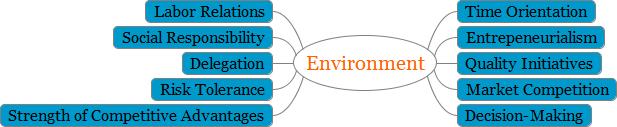
At the very minimum, the operating environment and organizational structure of each entity needs to be explored. When we are working with a client, we use the following two charts to help us ask solid questions about these two components of culture. From the answers received, we make value judgments and recommendations as to the degree of “fit” between organizations and what to do about it.

In considering the operating environment, we look at whether the company has a long-range or short-term approach to management. We ask questions to determine whether the organization is more entrepreneurial or bureaucratic. Quality initiatives are a good indicator of what aspects of performance are most important to management. The degree an strength of market competition for each party is important. How decisions are made is another leading indicator of what it may be like to work alongside the other team.

How management handles relationships with employees, (unions), and contractors is important to search out. Is giving back to the community and having respect for the environment a value of the other organization? Do meaningful tasks get delegated effectively, or are there barriers to professional development , shared responsibility, and growth through the contributions of many? Discovering how the other party perceives risk and builds strategy accordingly is a key conversation. When one’s competitive advantages are articulated, it is vital to verify how strong they are in the eyes of the buyers.

In addition to the operating environment, it is critical to understand the organizational structures that represent the philosophy of your intended. Do employees have direct access to top executives, or must they work through a layered management team? Understand whether the employees feel that they are protected to the point of not being allowed to make any mistakes. Examine whether generalist skills are valued versus everyone having a narrow scope. Look at the board of directors to see whether it is comprised of objective, strong leaders. Pay attention to the diversity of the employees and management team.

If the other company has a multi-office system, is it managed out of corporate, or are those in the field given autonomy? Notice whether task or relationships seem to carry more weight. Analyze the turnover rate among management and key positions. Is the human resources department deep enough to undertake complex issues like training and development, talent management, succession planning, coaching and the like, or compliance focused? Ask for examples of how technology is used to solve problems and enhance work flow.

The careful review of these “soft” factors can save you some headaches and hardships–do it! (We would love to help.)


Innovation vs Distraction: Got a System?

Last night, I attended an IdeaSlam at the Cary Innovation Center. Several different entrepreneurs–some with companies already and others with only ideas so far–each gave their two to three minute spiel before receiving feedback from the crowd and EntreDot staff. The variety of thoughts was impressive. So, too, was the passionate advocacy of what the presenters felt inspired to do. I wondered, though, what happens when passion wanes due to setbacks…

It’s not enough to have a good (or even great) initial idea…the best predictor of success is how the idea is nurtured, problems solved, and opportunities explored.  In order to become successful, the entrepreneur must continue to be curious. Reading extensively, attending events where nuggets of wisdom can be received, and simply taking time to think are all ways to keep the idea alive.

While a commitment to pursue a free flow of learned information is admirable, what is most desirable is learning how to discern between them and hone in on the best ones. Best practice is to develop a process to vet new ideas (not a totally new business idea mind you, but rather a “how to,” “when to,” why to” pursue your original one. With a process in place, distinctions can be made between new opportunities and new tactics or ways of doing what you do. A value judgment must be placed on whether giving the new thought earnest heed and an investment of time and effort will move the organization closer to accomplishing its mission or become a diversion.

In addition to evaluating new thoughts on the diversion–>mission scale, it can be helpful to analyze them based on internal and external impact. Does pursuit of the thought give the company a chance to accentuate something it’s good at? Or, overcome something at which it is weak? Does the thought have the potential to help the company thwart a market move by a competitor, or pioneer a new “blue ocean?” 

Thirdly, what other ideas have to be set aside to pursue the new one(s)? Resources are in high demand in a start-up company. If talent and time and “treasure” are invested in something new, what might suffer by comparison? Perhaps your “back of the napkin” cost vs. benefit analysis indicates that the new thought is worthy. Then what?

The new thought must “grow legs!” In order for it to have its intended effect, planning must occur. Figuring out what steps need to be pursued includes breaking a big idea down into smaller ones and devising a custom approach for each one. Within approaches, strategies and tactics, with actionable due dates, become the blueprint to build a better mousetrap.

Prepare Yourself to Become an Entrepreneur

There are two divergent schools of thought about whether entrepreneurs should get big company experience before starting a new business.  Some feel that learning how to run a department or project is a good training ground for managing a company. The argument is that entrepreneurial lessons are costly and it is better to learn “on someone else’s dime.”

Dave Lavinsky (the founder of Growthink), in an Inc magazine article, did start out with a corporate career, but feels it’s a bad idea:

Sure, you can learn some things from big companies–mainly how to run a big company. You’ll learn the type of corporate structures that are needed and the key departments, etc. But most of that doesn’t help you when you first start a company. For that, you need to think very differently. You need to think and act like an entrepreneur, which is the art and science of accomplishing more with less (less money, less human resources, less time, etc.)

Big companies are not great at accomplishing more with less, nor are they great innovators. So it’s very easy to pick up bad habits that actually make it harder to start your own business.

While the highly creative type can come up with an idea, it is often said that strong technical capabilities don’t necessarily translate to management and leadership abilities, let alone other significant soft skills requisite for successful start-ups.  General management/ jack-of-all-trade knowledge usually only comes through experience.  This factor prompts delving into how an entrepreneur can find the necessary experience to be successful. Lavinsky says, 

One option is to find a slightly older co-founder who has more managerial experience. Another option is to form a Board of Advisors consisting of several experienced entrepreneurs who lend guidance and advise. Another option is to raise funding and use it to hire several seasoned managers to help guide you.

If these options–either separately or pursued in concert with one another–seem daunting in terms of how someone with no prior business experience could feel qualified to identify and select such input, then there are other ways to gain experience besides working for a big company. One is to work for a VC-backed start-up. Another is to work as an independent sales contractor. Regardless of the type company that you may ultimately start, learning how to overcome rejection and meet quotas is going to be very important.

In summary, most successful entrepreneurs feel as though big company experience is incongruent with the skill development necessary to become a good entrepreneur. Yet, either by association with others possessing experience who join your start-up, or by acquiring skills before start-up, every entrepreneur can prepare.