Lukewarm Defenders of Change

Inside every company there is a culture. In order to remain competitive, companies need to make cultural and process changes that are holding them back. How the employees respond is a critical predictive factor in the achievement of the desired outcome.


“There is nothing more difficult to take in hand, more perilous to conduct, more uncertain in its success, than to take the lead in introducing a new order of things; because the innovator will have for enemies all who have done well under the old conditions and only lukewarm defenders in those who may do well under the new.”

-Machiavelli

As Machiavelli points out, leading others to a new order is tough work. Here are some management suggestions on how to make it a part of your culture:

Know your people

  • What is the thing they like most about their position? What would they change?
  • Have them explain why they are on this particular career path.
  • What do they think about the company and its management? What do they believe should be done differently?
  • Ask them who have been the greatest influences in their lives/careers. Listen intently and ask follow-up questions.
  • Ask what they like to do away from work.  Don’t make them uncomfortable. Make it known you are interested in getting to know them as people.
  • Share what values are important to you and why. Provide some stories where appropriate—people relate to stories.
  • Find out about their personal and career goals; share your own.
  • Become vulnerable. Ask what you could do better to serve them and the department/company.

Please remember to respond with empathy.  Demonstrate sincere interest in what your people say, significance to them, and how they feel about it.

Assign properly

1.    Delegate those things that would be helpful to you and to their development.

2.   Select the most strategic person to complete the task(s).

3.   When possible, get the employee to create a plan to complete the task(s).

4.   Ask the employee to repeat back their understanding of the desired outcome and process.

5.   Have a mid-point check-in on complex tasks.

6.   Follow up in a positively.

7.   Consider the rotating tasks.

8.   Delegate tasks that enhance cross-training.

9.   Try to include some delegation to everyone in the group.

10. Ask for input at the end of each task.

Motivate

Internal Motivation:

Have the employee ask himself these three questions—

  • Do I have awareness about my passions?
  • What would I ideally like to look forward to each morning?
  • How do I make this ideal happen?

Discuss how the answers to these questions must factor into job responsibilities and performance.

External Motivation: How do you reward your employees?

The columns below offer employee types, potential felt needs, and some suggested rewards. For each employee, think about needs and rewards. (You may pull from categories more than once).

EMPLOYEE DESCRIPTION

NEEDS

REWARDS

1. Employee feels disconnected from others.

Likely Need:

Appropriate Rewards:


2. Solid worker boasts of recent accomplishments.

Likely Need:

Appropriate Rewards:


3. Someone who displays a knack for learning and innovation.

Likely Need:

Appropriate Rewards:


4. Turnover in a department causes an employee to withdraw.

Likely Need:

Appropriate Rewards:


5. A shining star complains about the lack of opportunity for advancement.

Likely Need:

Appropriate Rewards:


a. Security

b. Socializing

c. Esteem

d. Achievement

e. Power


1. A letter of praise sent to the CEO and a copy of it given to the employee.


2. The right to select and manage a project.


3. A dress-down day.


4. An opportunity to gain some training & development.


5. An extra vacation day.


6. Involvement in a new committee/team.


7. Peer “attaboys” posted in lunch room.


8. Opportunity to lead a presentation/team.


9. Reassurance that his/her position is vital.


10. Role in developing a new company program.

Resist the Urge to Resist Change!

Innovation is a word that is bantered about unwittingly by many. From its Latin root, it generally means to renew or change. Yet, many reduce innovation to invention—as in product-specific concepts come to fruition and production. If we faithfully apply the definition, innovation may be seen to pertain to any ideas to effect positive change that go from origination to transformation to implementation to systemization within an organization.

To make the mental transition from viewing innovation as invention to what it really is, one must see innovation as culturally transformative. What was can no longer be what is, and certainly not what shall be. Change is hard for many people. Making a commitment to continuous change can be downright overwhelming. Yet, choosing to take action when others are stagnant can create tremendous strategic advantage. Look at Steve Jobs and Apple after the dotcom bust of the new millennium.  As others shrank from R&D, fearful that the technology boom was forever dead, his group increased investment in innovation and they have prospered for it. Think Apple and technology are an isolated company/industry? Explain away the following mix of companies founded during poor economies: Disney, CNN, Hyatt, Burger King, FedEx, Gillette, AT&T, Merck, Coors, IHOP, Fortune, GE, and the Jim Henson Company.

During the agricultural age, the asset everyone wanted was land and the critical success factor was yield. Agriculture gave way to industry with manufacturing and processing facilities and their efficiency defining success. As information became a greater commodity than industry, computers and their speed became the yardsticks. Today, in the creative age, innovation is the key asset and, as a means of differentiation, determines ultimate success.

If your organization is to remain/become competitive in the current world economy and proliferation of information sharing, it is unlikely to do so without making a commitment to continuous improvement. Again, so as to not confuse this phrase with the Deming’s work in documenting kaizen approaches to manufacturing in Japan, let’s define what is meant. We are speaking here of a core value within an organization to not accept the status quo—to not become complacent.

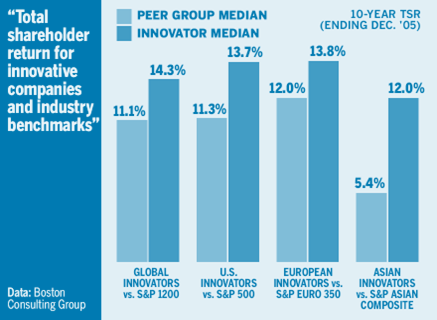
In a Business Week survey conducted in conjunction with the Boston Consulting Group in 2008, it was noted that total shareholder return (TSR) was greater over a three, five, and ten year period among business model innovators versus their industry peers.  Notice that it was those who innovated their business model rather than those who tried to hold onto their old one who prospered! TSR was greater among global innovators than the S&P 1200, greater among U.S. innovators than the S&P 500, greater among European innovators than the S&P Euro 350, and greater among Asian innovators than the S&P Asian composite.

“Wealth flows from innovation not from optimization.  Wealth is not created from perfecting the known, but imperfectly seizing the unknown.”

-Kevin Kelly, founding editor of Wired


In 1989, Smith Corona had annual sales of $500 million, producing typewriters. Word processing and computerization overtook their market position and they could not innovate fast enough to ride the wave. Jeremy Gutsche of trendhunter.com says, “Be wary of your strengths; success leads to complacency.” He maintains that, over time, most people stop trying. Need convincing?

  1. “We own that market.”
  2. “He’s been a client forever.”
  3. “She’s already my girlfriend.”

Gutsche cites each of these statements as examples of a pervasive attitude of entrenchment. Since most people are risk averse, we have learned to polish the “spin” on our actions and speak glibly of “tweaking” and “optimizing.” Instead, successful people and organizations must learn to pursue that which is splendid, unique, and paradigm-changing.

The secret, though, is to not just produce an innovative product or service; to not just culturally innovate, but to commit to innovation and change continuously. Daunting? You bet it is! How can you lead yourself and others to protect the value that innovation has created? How can change be “maintained?” This is a rhetorical question—it can’t! Change cannot be maintained—it must itself be changed to remain responsive, relevant & vibrant!!!

Getting Entrepreneurs Unstuck

So many businesses start with grand visions and hopes, only to miss the mark along the way. In our home state of North Carolina, 26000 businesses are started each year; but, 23000 fail each year as well. Without getting into the dynamics of how many survive for three or five years, we can at least ask the question “why?” Why do so many businesses fail each year?

Mismanagement, making mistakes others have already made, inadequate capitalization, and poor knowledge of systems and process resources are all contributors to business failure. The reason many of these mistakes are made is the lack of a sounding board for many entrepreneurs–someone to whom they can turn for ideas, resources, and encouragement. For centuries, there were very formalized apprenticeship programs in many industries that helped new workers become business people. In modern times, we use the term “mentor” to describe someone who is willing to work with an apprentice.

Management of a business is tough work. Having a mentor can make a big difference. Some of the things a mentor can offer include:

  • Business strategy and planning to make sure their business is focused on a viable market with a winning product and/or service that has a competitive edge
  • Forecasting and financing ensuring that sales plans are realistic and that cash is well managed
  • Operational discipline and judgment to increase the chances of success by making fewer mistakes
  • Industry connections that can help accelerate the business and its operations
  • Start-up company experience that can instill the wisdom of what it takes to really start and manage an emerging business

Organizations like EntreDot and incubators like the Cary Innovation Center and REDii in downtown Raleigh are but a few of the many resources that smart business owners seek out. The value is in having someone on site who can walk and talk  you through an issue that is new to you. The “someone” is often one who has more experience in business, but can also be a peer in these incubator environments.

Getting “stuck” on a tough issue is okay; staying in that predicament can put jobs, ideas, and investments at risk of loss. Regardless of whether you live in a community that has ready providers of mentoring or have to seek it from elsewhere, it is vitally important to your success to get help. Becoming “unstuck” makes life more enjoyable, fuels the economy, and builds better communities. Best wishes!

Pick 7 Marketing Trends for 2012

Lists can be so helpful for us to get our minds around the critical messages for a given subject. In a deliberate play on words, I wanted to juxtapose a “Pick 7” lottery concept with a “7 Marketing Trends” informational piece. Collectively, we can agree that any “list” is one person’s opinion and that it really is a “luck of the draw” as to whether applying someone else’s  recommended best practices will make a difference in your given market. Yet…simply attacking the subject matter sharpens our minds, encourages us to support our strategies with sound arguments, and generally makes for better decision-making! So…the list:

  • Location, Location, Location: Check-ins match message with timing
  • People are People: Listen, observe & match individualized message to feedback
  • Not One Size Fits All: Designing for multiple devices
  • Customers for Life: Customer retention through engaging multiple times
  • Behavior Speaks: Connect individuals based on how they interact with you
  • “Mocial”: Email, mobile, local & social
  • Dynamic Email: Static content is passe’; modernize!

With help from the folks at Silverpop, we hope to help you understand what’s at stake in each of these trends so that you may consider the impact to your marketing strategy and implementation. Location: think Facebook, Twitter & Foursquare–it’s important to help your customers share your brand with their friends. By combining incentives for people to let others know they frequent your business with intention in making it easy for your story to be told via email or social networks, you are able to create a user experience that keeps them coming back.

People: King Arthur Flour found that, by simply including quotes from customers in its emails, it was able to increase open rates, orders, and sales by 30%. What are you doing to move away from a generic message to a highly tailored one with a human element that is more engaging?

Device-specific: Smartphones and tablets are overtaking the computer world. Design with this in mind. If someone’s finger has to do the “clicking,” then spread clickable items out from one another and create “buttons” that are easy to use. Think about what you do/don’t like about viewing a website on a smaller device; make changes accordingly.

Retention: We’ve always heard that the customers we already have are the best ones and that soliciting a new one takes a ton of effort. Whether you are emailing those who have abandoned their online shopping carts, or reaching out with special campaigns to those who don’t usually open your emails, it’s important to think about getting as high a return as possible on the relationships we already have.

Behavior: Create a marketing database to track who visits your website, blog, online store, etc, what they do while there, whether they share your brand, and so on. Use tools like CRM to help track and segment your targets into smaller groups to whom you can send very tailored messages. Observe the response to the custom communications and refine what you send out.

“Mocial”: is a phrase used at Silverpop to explain the inter-connectedness of media and communications. What the connectivity means for you as a marketer is that thought must be given to how messages flow across platforms, how brand leadership can be stimulated and captured, and how to get users to check you out in as many formats as you are active.

Dynamic email: That should be enough to say on this subject, but some of us are thick-skinned (and -headed!) Consider: Air New Zealand sends customized pre-flight emails to passengers with information about booked destinations, crew members who will be serving on the flight, and social media buttons to share cultural articles, photos, videos etc about the local weather, itinerary or other matters of interest.

Challenging to think about? You bet! Determine to become a stronger marketer in 2012.

Management Inbreeding Retards Prosperity

If an organization’s people structure becomes too predictable and inflexible, it can enter into a season of decline. Regardless the legacy of success prior to the institutionalization of processes and preferences, its people can become inoculated to competitive shifts and a corporate “senility” may become omnipresent. Woe be the organization that thinks it can continue to enjoy today’s results tomorrow by only replicating what currently works!

  John W. Gardner, former chairman of Common Cause, likens the aging of a business model to the decline of the Westward frontier expansion. Vitality and enthusiasm give way to tradition and the dream dies with it. Once a management approach becomes entrenched, then, it is susceptible to challenges from every direction. If adjustments are not made, the “weak” are conquered by the “strong” (at innovation.)

The Boston Consulting Group used to do an annual survey to assess the total shareholder return of innovative companies versus their peer groups. Not only was it continually affirmed that innovative companies created greater returns, but the corollary finding was that reinvention of the business model yielded demonstrably higher results than simply changing products or services offerings. Prosperity proved evasive, then, for those management teams who had “inbred” in their perpetuation of what was familiar.

Frederick Kappel, former president of AT&T, during a lecture at Columbia University, cited six dangers of management inbreeding:

  1. People cling to old ways of working even though they have been confronted by a new situation.
  2. They fail to define new goals with meaning and challenge.
  3. Action is taken without studied reflection.
  4. Institutionalized contentment:Business becomes stable and secure, not venturesome.
  5. Old “wisdom” is passed on to new people. Older managers tend to adhere too rigidly to old ideas, to antiquated approaches and methods. Note, they mold the minds of young managers.
  6. Low tolerance for criticism acts to stifle independent thinking.

I remember hearing of a speaker at a turnaround conference who said that the antidote to such mismanagement lies largely in moving people around to different jobs on a regular basis. He argued that a type or rottenness took root when people held onto jobs (positions) for too long. He felt that giving people new challenges, rewarding the hungry “chomping at the bit” with opportunity to test themselves, was a way to keep the organization invigorated. By creating an atmosphere where people have the chance to perform, the whole company usually performs much better!