Spring Colds and Business Lethargy

Have you ever battled one of those seasonal colds that seems to set in just as the quarter changes? The kind that start out innocuously and, within a day or two, take over your body are the worst. With a stopped-up head, compounded by the medicine-induced slowdown of brain activity, perhaps a headache…you simply feel immobilized. Try as one might, even simple tasks require Herculean effort. Truly demanding focus–be it mental, emotional, or physical–wears out and leaves us exhausted.

In business settings, we can experience the onset of lethargy similar to the seasonal cold in cycles not unlike the changing of the seasons. Consider: when you finish your busiest season of the year, the week or so following can be extremely slow and unproductive; or a project comes to a close and your team is worn out; or your work group has just added a lot of new staff and some of your job is now done by others. While all of these situations seem to describe events that lead to a lack of work, what else can lead to job boredom?

Underemployment is a huge contributor to work environments in which employees (and management!) is under-motivated. How does this occur? Usually, when we take a position with an organization, we agree to a certain job description, rate of compensation and benefits package. However, we rarely talk about the career path, opportunity for advancement, and milestones that trigger promotion. If these items are discussed, they are discussed on the front end briefly because we read that we should. How can we keep the topic matter “front and center” throughout our relationship with an employer?

Much of it boils down to culture. Does your organization have intentionality/purposefulness about its culture? Is it “tuned in” to the needs of its employees, or only looking out for shareholder interests? While financial and accounting textbooks encourage us to only think about the “bottom line,” we all know that boring workplaces can be a downer and that culturally blase organizations lose talent, customers, and market share in the long term.

Either join a group that has a culture that values the employee, or be a change agent to help it become such! Speak with your supervisor, HR contact, etc about ideas that you have to enhance employee engagement. It has been our experience that, in many cases, executives have not only heard about progressive corporate cultures within their industry, but would like to have a reason to begin migrating in that direction. Keep in mind–“baby steps” are still walking! Perhaps you will be asked to join or facilitate an employee group to explore ways to make your office a better place to work. If so, you can escape the lethargy and begin to enjoy your avocation. Congrats to all who dare to embark on the journey from “medicine head” to lucidity!

Cultural Due Diligence Breeds Success(ion)

In a blog post (“The Human Side of Due Diligence”) of October 2011, Michael Bittle talks about the challenge of sizing up a company’s culture in the midst of a private equity transaction. Even if your team is savvy in its financial analysis, interviews customers and executives, and puts together airtight LOIs, he argues, you can miss the important undercurrents that are culture.  Too many companies are dressed up for a suitor, only to prove to look to good to be true.

A recurring drama plays out wherein performance swoons, key managers leave, and morale sinks as well. The investors scratch their heads and wonder what has happened. Enter the concept of the informal culture–what values, unspoken agreements, collaborative tendencies, etc existed prior to the transaction. Bittle argues that, in the heat of getting a deal done, that the quant jockeys often have neither the time nor the training to be extra discerning about these nuances than can be a company’s undoing.

In the Research Triangle Park, we are developing a national reputation for angel or venture-backed technology and life science start-ups that all aspire to make their commercialized product/service a household name. Along the way, they receive outside investment and some matriculate to a successful revenue path that ultimately leads to a liquidity event. Very few take an approach wherein the founders want to stay with the company as it matures. This can be good and bad. In the cases where the founder brought an academic mindset to enterprise, it is often better that professional management run the company longer term.  On the positive side, emotional bonds are built between employees 1, 2, 3 …and #50, #100, etc. These bonds create stability, a sense of community that can be disrupted by the introduction of outside ownership/management.

George Bradt, in an article in Forbes on February 8, “Corporate Culture: The Only Truly Sustainable Competitive Advantage,” takes the position that competitors, given time and money, can duplicate almost anything except culture. “In sustainable, winning cultures, behaviors (the way we do things here) are inextricably linked to relationships, informed by attitudes, built on a rock-solid base of values, and completely appropriate for the environment in which the organization chooses to operate.”

Organizational development principles can be brought to bear in the due diligence process if the consultant focuses on soft issues rather than concrete, easily measured ones. Whether an EQ assessment is administered to managers, or some type of DISC or MBTI with their direct reports, it can be helpful to understand who is the backbone of the company and how they may behave/make decisions. Transparency can drive smooth transitions if the former owners/executive team is willing to give the private equity/acquiring company access to employees earlier in the process. If people are made aware of the potential transaction and given an opportunity to design their own future, they are more likely to be/remain engaged in positive behaviors and outcomes.

Eventually, the first generation leadership will have to give way to new leaders, even if there is no transaction. The succession is more likely to be successful if the culture is aligned with the company direction through thoughtful interaction with employees and casting vision for how their contributions will continue to be needed. Such best practices are more likely to reinforce trust and a desire to build something great together.

Firms Outperform Industry By 22% With Design, Develop Deploy Approach

Would you like for your firm to be a market leader? Who wouldn’t, right? Yet, are the firm leaders willing to do what it takes to distinguish themselves from the crowd? If you are the managing partner, practice group leader, executive committee member, or key client group leader, you set the tone for culture and performance.

McKinsey found in a 2010 study that organizations who rank in the top quintile in talent management outperform their industry by 22%. By talent management, we mean grooming professionals throughout their careers to enhance competency, contribution, and performance–regardless the yardstick. However, traditional talent programs often fall short because they do not incorporate the best practices of organizational development.

Layers for Development

Organizational development components are more holistic and  include organization design, business development, work generation and management, and strategic business model communication.  The OD spectacles view recruitment, nurture, and retention of  legal talent as an expression of firm values, identity, vision, goals, strategy, and essence.  As Jim Collins in Good to Great describes the importance of helping the right people find the right seat on the bus, it is important inside firms to develop a system for aligning talent management with firm management.

The graphic to the right depicts the need for a cascading set of goals whereby organizational goals are broken down to team/practice area/section goals, and further still to individual goals. As firms find a way to chart a career development path that includes a competency model and clear role maps, the members of the firm and the teams on which they serve become more proficient in serving client needs and reaching business objectives.

Clarifying responsibilities for client acquisition, project management, and client retention guides the development of assignments that groom not just the technical, but also the soft skills necessary for achievement.  Competencies such as self awareness, self regulation, motivation, empathy and social skills  can be developed as a vital part of an overall career development plan that intentionally aligns experience, assignments, and mentoring needed with the exigency of getting billable work done.

  • Design your organization for success
  • Develop your people for greatness
  • Deploy human capital to serve meaningful client needs

Senior Night & Going Away Parties

If you are the type person who enjoys college sports, chances are high that you have witnessed a few senior days/nights during your cheering. Those who are finishing out their intercollegiate athletic careers are celebrated, given a chance to be the star, and walk out of the gym/off the field with their heads held high, regardless the outcome. In like fashion, in the business world, we often have going away parties for those moving on to new opportunities.

WHY do we have parties when someone who has been a part of our organization decides that somewhere else will make him/her happier? Unless, as may be the case, you plan to follow the departing, your reaction ought to be one of introspection. What part of the culture where you work is needing improvement so that employee engagement and retention are raised high enough that people wouldn’t think about going anywhere else?

so happy for YOU!

Recently, I had the opportunity to listen to a conference speaker (Michael Lorsch) speak about the need for organizations to be both smart and healthy. Smart is the category where most managers and employees live: services/products, strategy, marketing, finance/operations, and technology. Healthy, however, is characterized by those “soft & fuzzy” difference makers that constitute an organization’s DNA (culture): minimal politics, high morale, high productivity, minimal confusion, and low turnover. So….an organization wherein people would rather leave than stay in not healthy and, therefore, not likely to be as successful in the long run as one that is emotionally healthy.

In order to build health and overcome dysfunction, Pat Lencioni (Lorsch’s boss) recommends five roles for leaders:

  • go first to build trust
  • mine for conflict
  • force clarity & closure
  • confront difficult issues, and
  • focus on collective outcomes

Why not change your culture and make a HUGE deal about new employees? Become more engaging. Mourn when others leave and figure out why so you can work on the business instead of in it!

One-man rule vs. One-man band

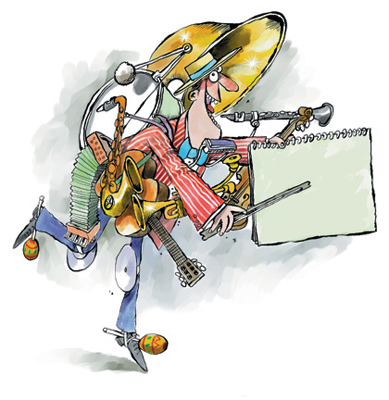
Businesses often can be managed by a strong leader who seems to be involved with every significant decision. In some cases, this type of one-man band is almost unavoidable (e.g. a company with less than five employees, four of whom are in support roles.) However, in organizations that have been fortunate to grow, add management teams, and have complex issues, the controlling leader can either be an icon or an albatross. When is it good–and when is it bad–that the proverbial “buck” stops on one person’s desk?

art by Eldon Doty


Chief executives who make decisions without the input of colleagues engage in one-man rule. This practice is a two-edged sword. While few will argue that group management can slow progress and that one can move more nimbly than many, there is always the latent risk that decisions that are made lack depth, insight, and the benefit of buy-in. The biggest travesty of the urge to “go it alone” is that it undermines management succession by depriving others from the opportunity to make meaningful choice on behalf of the enterprise.

Management depth is always in the list of prime characteristics of best managed companies. Management change then, by default, becomes a disorderly process, at times exacerbated by recession or prosperity. The entire organization is often thrown into chaotic operation and often requires a turnaround thereafter.

Instead of putting one’s peers–and, perhaps, one’s own retirement via earnout/sale–at risk, better to avoid one-man rule and seek to engage others. This concept holds true in may of the sexy technology start-up models as well, wherein the “one-man” is equivalent to the group of initial founders who can function as to inhibit the contribution of successive hires. Often, these top executives are extremely bright and have a very high IQ, but lack the EQ (emotional quotient = emotional intelligence) to build out the model and achieve the important milestones due to an unwillingness to invite the input of others.

More to come on how to build out the management team and empower them to make meaningful contributions…