Creative – or Not? Characteristics to Consider

Innovation and intrapreneurship rely on creativity. How do you know whether you or others in your organization are creative? We’re not talking only about artists when the term “creative” is used. By examining behavior and thoughts, it is possible to get a feel for what a broad audience my agree constitutes creative talent. Jeffrey Baumgartnerauthor of the book, The Way of the Innovation Master, believes that two behavio(u)rs are predictive of creativity:

Behaviour One: Make More Use of Their Mental Raw Material

It seems that when highly creative people are trying to solve a problem or achieve a goal, particularly when the goal is related to their area of creative strength, they use much more of their brains than do ordinary people or, indeed, even themselves when not focused on a creative task. If the average person is asked to draw a picture of a cat, she will most likely think about the physical appearance of a cat and replicate it as best she can with pen and paper. The creative artist, on the other hand, will think in much more depth. She’ll think not only about the cat, but the placement of the cat; what the cat is doing; the lighting; the kind of lines to use and much more. She may decide to humanize the cat and give it emotions. Perhaps she’ll decide to draw a sexy cat with a human body wearing an evening gown. Maybe she’ll simply draw a blur representing a cat in motion.

By using much more of her brain to achieve her goal, the highly creative person in effect provides herself with more raw material from which to construct ideas than the average person. The average person thinks only about drawings of cats and the basic characteristics of cats. This limits the level of creativity she can achieve. The highly creative person thinks about much more — all the while retaining some connection to cats. It is not surprising that, with so much raw material, she is able to be more creative in the realization of her ideas.

They Think Before They Act
It takes time to run through all that raw material in the brain. This is why creative people tend to think before they act. The play with the issue in their minds for a time, looking at a range of possibilities before choosing a direction. I see this when I work with creative people. When you give an average person a creative challenge, she tends immediately to try and come up with ideas. But because her mind is too focused on the issues of the challenge, her ideas are limited in scope as well. 

Incidentally, the highly creative person does not focus on her left brain or right brain for a simple reason: it’s a myth (Christian Jarrett (June 2012) “Why the Left-Brain Right-Brain Myth Will Probably Never Die”; Psychology Today.) Creative people use a lot of their brains, not one hemisphere or the other!

Curiosity Is Creative Play
Rather than simply collect information, their brains play with it. One person might see a horse standing in a field and think it is a magnificent looking animal. Another, more curiously creative person, might wonder what the horse thinks about all day in the field. She might wonder how the horse can cope for long hours of inactivity without a book to read. 

Spontaneous Ideas
For instance, it is by asking what use could be made of not very sticky glue that some people discovered Post-Its. Pablo Picasso wondered how he could depict three dimensional reality, as viewed from different perspectives, on a two dimensional canvas and came up with cubism.
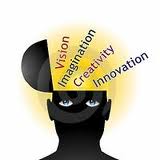
Creative mind
Behaviour Two: Less Intellectual Regulation

The dorsolateral prefrontal region of the brain is responsible for, among other things, intellectual regulation (Simon Ross (2008) “Dorsolateral prefrontal cortex”; Psychlopedia). It includes the brain’s censorship bureau; the bit of the brain that prevents us from saying or doing inappropriate things. It seems that in highly creative people, this part of the brain becomes much less active than normal during the period of creation. It is not that highly creative people are not afraid of ridicule or criticism (indeed, many artists are highly sensitive). Rather, it never occurs to them that others might ridicule their ideas.

Creative People Are Not as Rebellious as You Think
Instead, they follow their own rules or systems for evaluating ideas and deciding whether to move forward with those ideas. These rule systems are often logical, at least to the creative thinker. An artist, for example, will not make a name for herself by studiously copying current trends. Rather, she will become famous by being unique. 

Creative People Are Logical
That logic may be based in part on emotions and feelings — especially in some artists. If anything, by not feeling compelled to fit the demands of popular culture, the creative artist needs to be even more logical than the average person who assumes that if everyone wears and buys a particular style jacket, then it is safe to buy and wear such a jacket.

Creative People Tend to Be Less Honest
Research by Francesca Gino and Dan Ariely (Francesca Gino, Dan Ariely (2011) “The Dark Side of Creativity: Original Thinkers Can be More Dishonest”; Harvard Business School Working Paper) confirms that, in general, highly creative people are less honest than averagely creative people. The reason for this seems to be that creative people can use their creativity to justify their actions in ways that less creative people cannot do.

Develop Innovation Skills Through 6 Techniques

When we write of intrapreneurship, we are addressing the need for businesses to foster innovation. While process and procedure can create a friendly environment in which creativity can occur, there are times when some individuals inside an organization need a jump start. How does an organization encourage its people to overcome what would be called in literary circles “writer’s block?” For, if your company can identify how to unleash the power within the minds of its employees, great things can happen on behalf of the customer and the company and its stakeholders–including the employees!


Catch 22Woody Bendle penned an article for Innovation Excellence recently highlighting that innovation instincts can be sharpened and expanded. It is necessary, according to Bendle, to “sharpen your instincts.” Bendle reminds readers of Malcolm Gladwell’s writings (Blink and Outliers) on how to become more intuitive. Gladwell, says Bendle, “provides several deliciously compelling examples of the human “Adaptive Unconscious” at work. This Adaptive Unconsciousness is discussed as one’s ability to intuitively connect a myriad of seemingly disparate dots in a split second in order to form an accurate expert opinion. And, fortunately this Adaptive Unconsciousness is something that one can develop over time.”

Furthermore, writes Bendle, Gladwell makes the case for developing “expert” knowledge and abilities through what he calls “The 10,000 Hour Rule:”

Gladwell’s thesis is that after 10,000 hours immersed in a particular field or activity, one begins to have a seemingly innate level of knowledge or capability. Put another way, with 10,000 hours of effort you can take your Adaptive Unconsciousness (instincts and intuition) to a new, almost uncanny level. But at this point, one’s expertise is potentially narrow, and one way to bring even more value to your innovation process is to expand your instinctive base.

Bendle suggest the following 6 techniques to awaken your latent innovative capability:

  1. Occasionally take yourself out of your daily, weekly and monthly routines. You’ll be amazed by what doing something different or doing something differently can do for your mind.
  2. Purposefully seek out the new and the different – and pay attention. There is a whole lot of life going on out there and to borrow a quote from Ferris Bueller – “If you don’t stop and look around once in a while, you could miss it.”
  3. Go Wander and Wonder. Go see, do, and experience something completely out of your wheel-house. Get out of your comfort zone and whet your appetite for confusion. Seek out things that are amazing to you.
  4. Challenge your senses. Take a moment every now and then to mentally catalogue what your senses are experiencing and then, maybe even push them a little further.
  5. Make note of things that inspire. Each of us are moved in different ways. Pay attention when you are inspired. Ask yourself why you were inspired. Make note of what this feeling is inspiring in you.
  6. Play! Have you ever spent any time watching two young animals playing around or rough-housing? They are developing their instincts and this is one technique that we human simply don’t do often enough.

Try these techniques the next time that you are trying to solve a tough problem at work. See if they propel your thinking toward greater objectivity and clarity. If you find that the techniques are working for you, take it to the next level by sharing your experience with co-workers, a supervisor, or subordinate. As more people learn to think about the everyday work world with more innovative mindsets, “breakthroughs” should become far more common and frustrating “Catch-22” situations less so!


Failure to Innovate Spells Decline

History has a way of repeating itself. JP Nichols, the CEO of Clientific, recites a passage from Theodore Levitt’s 1960 treatise “Marketing Myopia“ to illustrate how railroads missed a window of opportunity in their business life cycle:

“The railroads did not stop growing because the need for passenger and freight transportation declined. That grew. The railroads are in trouble today not because that need was filled by others (cars, trucks, airplanes, and even telephones) but because it was filled by the railroads themselves. They let others take customers away from them because they assumed themselves to be in the railroad business rather than in the transportation business. The reason they defined their industry incorrectly was that they were railroad oriented instead of transportation oriented; they were product oriented instead of customer oriented.”

railroadThen, Nichols makes the connection of this faulty business strategy to the modern banking system. As an industry, he feels the banks have become product rather than customer focused. Here’s how he describes the slippery slope slide into irrelevance:

Mature industries erode subtly at first. Hungry upstarts nibble at segments too small or unprofitable for entrenched incumbents to waste much energy protecting. But eventually the new entrants gain traction and move upmarket to larger and more profitable segments. And new categories are invented along the way.

Then, as it relates to banking, he writes:

Economic cycles wax and wane, but people will always look for ways to save and borrow, to move money from one place to another, and to occasionally get some advice from someone they trust. Traditional financial institutions like banks and brokerages held a near-monopoly on those activities for generations, but banks that continue to be bank-oriented will continue to lose to an increasingly broad group of competitors that are truly customer-oriented.

Think about what’s been happening around the edges of the banking industry. Peer-to-peer lending platforms and retailers’ captive financing programs have taken lending business that once was nearly the sole province of banks. New payments ventures like Square and Dwolla provide services that people want to use because of their great design and ease of use. SigFig is an online registered investment advisor with over $50 billion in assets tracked on its platform. Innovative startups like Simple and Movenbank are reinventing the whole notion of what it even means to be a bank.

The scariest part? None of those companies even existed five years ago.bank

In contrast to the banks’ inability to anticipate the needs of consumers as well as these new enterprises, Nichols salutes another highly regulated industry, healthcare, which he says, reinvests 10% to 15% of its revenues back into research and development, and “represented 21% of the $603 billion spent globally on R&D in 2011, according to a Booz & Co. study. Financials don’t even make the list, lumped in instead with the 2% of “other” industries, collectively in tenth place.”

Nichols, who was the first chief private banking officer for US Bank, challenges the industry to redefine what business they are in, as the railroads should have but didn’t. He feels that a redefinition of the industry to become more responsive to consumer needs and niche services to serve them would be revolutionary.

But, set aside railroads and banks. Look at your own organization now. How can you become more innovative? How can you light the fire of intrapreneurship so that it burns brightly a generation from now? Very simply: begin with the customer in mind and build something that will blow their socks off in terms of its ability to resonate with deep seated needs. Go do it!

Harness or Release the Intrapreneur Troublemaker?

Recently, the World Economic Forum convened in Davos for its annual meeting. What, one may ask, does such a high brow event have to do with intrapreneurship and innovation in business? Actually, one of the panel discussions at the Forum was on social intrapreneurship. The definition that was being used seemed to focus on the social implications of the issue as it relates to those change makers who offer creative solutions and drive growth. Gib Bulloch, the Executive Director for the Accenture Development Partnership, writing for the Huffington Post last week, noted that there exists no job title for the social intrapreneur. Admittedly, he argued, no one leaves college or university to become one and the  role lacks a clearly defined job description. Companies that embrace the power of these intrapraneurs to think differently and innovate, Bulloch said, have significant opportunities to leverage their passion and benefit the business.

Bulloch recalls Vodafone’s M-PESA mobile banking business as a prime example of the benefit of empowering intrapreneurs:

The idea of using mobile phones as bank accounts for the un-banked in Kenya was not born in the corporate boardroom. It was the brain child of a middle manager in the marketing department, Nick Hughes, who came up with the concept and brought it to the attention of those who could advance its development, both inside and outside the company. Seven years into the program, a thriving M-PESA business now delivers socio-economic benefits for Kenya and business benefits for Vodafone.

Therein lies the key to social intrapreneurship. It is not a corporate social responsibility (CSR) program. It is a business growth initiative that tears down barriers and embraces the passionate ideals and innovation of the millennial generation now flooding into the workplace. It is a concept that captures the zeitgeist of young people who care less about making a fortune on Wall Street and more about making a difference on Main Street.Intrapreneurman

For organizations that aspire to leverage the rare win-win of business benefit with social good in 2013, four key takeaways have emerged as guideposts for developing an effective social intrapreneurship program:

• The role of leadership is key: In the early stages of an innovation program, leadership must provide the air cover required to protect bottom-up ideas. As the best ideas mature, they must be promoted within the organization and embraced from the top down.

• Harness the troublemaker: Social intrapreneurs are at their core different from their peers. They march to a different drum beat and their passions fuel both their personal and work lives. Having a culture that both nurtures the change maker’s innovative spirit but also harnesses the troublemaker’s enthusiasm and energy to break molds and achieve where others have come up short will return significant rewards.

• Realize the retention value: For the social intrapreneur, making a difference is often equal to making money. For organizations that embrace the value of providing “bottom up” channels for creative business solutions that provide social good, the long term benefits for retaining your best innovators cannot be understated. Simply put, for the millennial generation, making a difference matters.

• Base decisions on the Business Case: Even for the most passionate social intrapreneurs, the numbers still matter. Innovations that pull on the heart strings as opposed to the levers of business value are unlikely to be sustainable or scalable in the long run

How do you see these guidelines at play inside your own organization? Is top leadership committed to openly supporting new ideas? Are those who see the world differently perceived as liabilities or assets? What are you doing to keep these change agents engaged and motivated? Does your group operate on emotional or sound business foundations? Harness the power of the intrapreneur!


Know the Customer Before Business Planning

Previously, I have referenced the column from Inc.com on “Herding Gazelles,” written by Karl Stark & Bill Stewart. These guys have a consultancy that works with businesses on strategy as it relates to attracting investment. Their contributions to Inc are well thought out and I enjoyed this morning’s edition:

We have been working with an early-stage enterprise tech company to help them get their product to market. We recently gathered to watch their first customer installation. They were naively fearless–they knew things would go wrong, but they didn’t know what or how severe the problems would be.

No one, however, expected the install to go as badly as it did. If there was a feature that could be broken, it was. If there was a process that could be challenged by the new technology, it was. If there was a remote possibility that some network setting would cause chaos, it did.

All the testing they did in advance didn’t prepare them for “real” users. The tech team was at first horrified by the volume and severity of the challenges they experienced. But then something amazing happened. They showed us exactly why we are excited about their potential.

They took a deep breath, stopped trying to gloss over the challenges, and instead embraced their flaws. They encouraged users to try to break things. They feverishly took notes as they learned what they needed to do better.Customer insight wordle

The customer wasn’t scared off by the bugs because our client had prepared them for possible issues. The team was honest about where the problems were, but more importantly, they showed the customer their resolve to learn everything that they could to develop a great product. The customer’s attitude actually shifted from tolerance to excitement as they realized the system was going to be refined beyond just fixing flaws and that they were going to be a part of designing a system that they would love to use.

The tech company accepted that they didn’t know it all and eagerly solicited feedback from the customer. The experience gave them the best free product development input they could ever expect.

We thought to our own client experiences, and the experiences our other clients have with their customers. If we can all listen to customers as openly as this tech start-up did, we will not only build great products and services, but we will forge the sort of lasting relationships that most companies seek.

When developing new products and services, it’s good to trust your intuition and your internal expertise–to a point. But when an opportunity to learn from a real live customer presents itself, you need to be all ears. You can’t possibly know it all if you don’t recognize the wisdom of others.

What is recommended here echoes what I am sharing with entrepreneurs on a recurring basis: until you fully understand the needs of your (target) customer, you are fooling yourself as to the viability of your business model. Taking the time to first identify target market segments, then messaging appropriate to each, followed by testing your proof of concept in an effort to revise your offerings is Business 101.

We are passionate about the need to understand how your target buyer thinks, what is important to them, and how you can produce something that they perceive as highly valuable. Asking is a great start! Slowing down from product or service development, let alone ongoing business operations, and asking yourself tough questions requires discipline and commitment. Kudos to those who are strategic enough to realize the potential compound payback on the investment!