Qualifications of a Turnaround Adviser

An effective turnaround adviser must be uniquely qualified to deal with crises and prepared to assume responsibility for the company’s success. The three most important background credentials for an adviser are as follows:

  • an identification with the needs of declining companies
  • specific industry expertise in your industry or a related one, and
  • a track record of overcoming adversity and making the most of poor situations

General Requirements

When evaluating possible advisers, teams should look for someone with both practical, hands-on capabilities and an educational or research-based knowledge of the issues at hand. Make sure you do not have a novice attempting on-the-job training at your expense. It would be wise to find someone who has performed at least a dozen turnarounds individually and who has access to other personnel with the same or greater levels of experience. Furthermore, familiarity with research and educational publications within your industry that highlight concepts of turnaround practice gives an adviser a more objective view of workable solutions to difficult problems.

Industry Expertise

A background in your industry prepares an adviser to face the peculiar, industry-specific dilemmas that invariably arise. Previous work with companies of various sizes and in various markets furnishes the adviser with extensive–and beneficial–exposure to your industry. A proven ability to learn new markets overnight and employ existing operating resources effectively will result in quicker turnarounds. Examine the methods the adviser used with prior clients and determine whether similar programs would make a comfortable fit for your business. “Sanitized” copies of turnaround plans produced for other clients may even be requested.

Success Rate

A turnaround adviser’s success rate with previous clients is an important statistic. Much as a baseball team manager would hesitate to hire a pinch hitter who batted below .200, the executive team must exercise caution in selecting someone to captain the turnaround team. Most advisers who have been in business for more than five years can claim a one out of two (50 percent) or greater rate of success. To reduce risk, the team should look for an adviser who can claim–and substantiate–an 80 percent or better success rate. Once a successful adviser has been located, the team shout contact references and ask what made the effort a success.

Crisis Management

Effective turnaround advisers must possess certain qualities and characteristics that uniquely prepare them to deal with crises. The first such quality is “multilevel simultaneous thinking”–the ability to solve problems on several different levels at the same time. This is a skill gained over time through both education and experience. The ability to interact with numerous employees to resolve multiple dilemmas and relate to each in an appropriate manner is also essential.

Negotiating with Opponents

A turnaround adviser’s ability to search for all the important details, address issues with a penchant for opportunism, and follow through on commitments will also further the turnaround process. Note that “opponents” emerge in turnarounds virtually overnight; they tend to be former allies such as lenders and vendors. Being able to decipher an opponent’s true bottom line and make an offer that more than covers his or her threshold yet preserves the company’s position will save the company precious time during the turnaround. Indeed, many of these opponents in negotiations will return once again as allies when the business emerges from its decline. In completing a cycle of commitments to stakeholders, the turnaround adviser should ensure that every promise made can be carried out to the letter. Such consistency in following through on promises will enhance the builder’s credibility and image in the community.

Often employing little more than intuition, a crisis-oriented adviser can anticipate pitfalls and plan around them before trouble occurs. Being able to foresee a turn of events is a rare quality to begin with, but is especially valuable when coupled with the creativity that allows the adviser to adapt the flexible strategic plan to the changing demands of the situation. This ability to adapt to change is a necessary elastic band in the adviser’s armor, without which all other tactical weapons would be useless.

 

Sizing Up the Competition

Whether you are in turnaround mode, wildly profitable operations, or somewhere in between, it is imperative to know as much as you can about your competition. Competitive threats–present or forthcoming–should be well understood and strategies developed to address them.

Assessing the Competition

To assess buyer potential, knowledge of competing products is essential. Any advantage an executive team may hold over the competition needs to be studied with an eye toward exploiting that advantage fully. By developing this competitive advantage, the business creates non-financial barriers can prove difficult for the competition to overcome; financial barriers (for example, price discounts) are often more easily met.

Threats from competitors are a daily occurrence. Therefore, the competition should be monitored and key information compiled and categorized, either manually or electronically, and updated regularly. The most common forms of threat to watch are as follows:

  • the unanticipated entry of competition with extensive resources or new product offerings into the local market
  • the diversification of existing companies into new product offerings
  • the introduction of  a technology (such as a software as a service trendsetter) that exceeds currently available prototypes
  • efficiency improvements that create cost advantages not easily matched

Any slight advantage in cost savings others can gain presents a viable threat to the operation of every other participant in that niche. For example, if a company can source inputs cheaper, that competitor can control the market through pricing. While price reductions can be matched, cost efficiencies cannot. With reduced cost structures, the business could offer higher quality products for the same or cheaper prices to the same group of buyers another business is trying to attract. Some may strike lucrative deals with their vendors, who are in effect “held captive” by their need for the contract work. Streamlining staff or other reductions in overhead can also contribute directly to the bottom line and clear the way for improved price competition.

Gathering Information on the Competition

Given the possible threats, every company should study and know its competitors inside and out–not just figuratively, but objectively, analyzing competitive products in the field and the team(s) that produce them. If a competitor suddenly pulls out of a channel or wholeheartedly pursues another, the executive team should wonder and try to determine the reason. If you are playing in the same space, detailed information on the features, marketing and expected pricing of the offerings of others can be extremely valuable. More difficult to collect, but perhaps even more valuable, is information on a competitor’s cost structure. Knowledge in these areas prepares your team to position its offering in any given situation. This information can and should shape planning.

Information can be gathered from websites, especially press releases, industry publications and organizations, and word of mouth. Suppliers, services firms, and buyers are valuable sources of competitor information. Of course, such information must be considered in light of the motives of the person providing it. Proactive research in terms of surveys and interviews can also supply good background data. Most important–and easiest to obtain–is information from marketing agencies and sales organizations that serve multiple clients.

Gaining a Competitive Advantage

Companies gain an advantage when a known, unique asset is translated into a more competitive offering. Therefore, the executive team should carefully note opportunities to gain an edge throughout the information-gathering process. Capitalizing on company strengths–and opportunities to serve the market thereby–will instill the confidence necessary to withstand outside threats. Addressing buyer concerns in a positive manner, funneling their input into a constructive, sales-closing process, will enable the business  to make the most of both strengths and weaknesses. For example, by offering option packages and upgrades based on buyer demand, the company can secure more contracts. Meeting delivery schedules is also critical to enhancing competitive advantage. 

Customer service is another important area to scrutinize. Satisfied customers are a great source of new, repeat, and referral business. By carefully pre-screening potential buyers and collecting selection information, more targeted sales efforts can be made. Teams should expect prospects to respond to customer service before and after the sale as though the sale depended on it.


Common Danger Signals of Company Decline

Previously, we have examined the internal and external elements of decline and some of the early warning signals of each. Notably, we have made the distinction that, while internal elements are easier to control, external elements are capable of being influenced as well. It is the responsibility of the executive team to coordinate marketing and sales, operations and finance in such a way as to anticipate changes in the environment and plan accordingly.

The clear danger signals of decline vary with the stages of decline, and become more serious as the decline intensifies. Some of the common danger signals are as follows:

Common Danger Signals

Early Decline:

  • shortage of cash
  • strained liquidity
  • reduced working capital
  • stretched accounts payable
  • late accounts receivable
  • reduction of return-on-investment (ROI) by 20-30 percent
  • flat sales
  • several quarters of losses
  • increased employee absenteeism
  • increased employee accidents
  • increased customer complaints (product quality, delivery)
  • late financial and management information

Mid-Term Decline:

  • increasing inventory
  • decreasing sales
  • decreasing margins
  • increased expenses
  • increased advances from banks
  • requests for additional considerations from banks
  • late and unreliable financial and management information
  • erosion of customer confidence
  • accelerated accounts payable from vendors
  • overdrafts at the bank
  • delayed accounts receivable from opportunistic customers
  • violation of loan covenants
  • bank used to cover payroll
  • increased interest rates on indebtedness from banks due to increased perception of risk

Late Decline:

  • little attention  paid to profit decrease
  • staff cutbacks without analyzing cause of problems
  • overdrawn bank accounts as substitute for line of credit
  • cash crisis
  • accounts payable 60-90 days late
  • accounts receivable 90+ days late
  • further decline in sales
  • extremely low employee morale
  • eroding company credibility
  • excessive decreased inventory turnover
  • supplier restrictions
  • fewer reports to bank
  • qualified opinion from auditor
  • bounced checks
  • cutoff on supplies
  • credit offsets
  • accounts receivable continuing to age
  • further decrease in margins
  • further decrease in volume of sales
  • increase in uncollectible receivables
  • no liquidity
  • depleted working capital
  • lack of funds for payroll
  • ineffective management
  • attempts to convince creditors that company is viable and that liquidation is not necessary

Signals That Can Occur At Any Stage:

  • decreased capital utilization
  • decreased market share in key product line(s)
  • increased overhead costs
  • increased management and employee turnover
  • salaries/benefits growing faster than productivity/profits
  • increased management layers
  • lost market share to competition, which is not keeping up with marketplace changes
  • management in conflict with corporate goals and objectives
  • opposing directions for company and management
  • sales forecasts that predict that company can sell its way out of difficulty
  • poor internal accounting
  • credit advances to customers who do not pay on time
  • non-seasonal borrowing
  • sudden overdrafts
  • increased trade credit inquiries (a signal that new vendors are being sought out)

Not all of these symptoms may appear; it is sufficient cause for self-examination if some of them occur. As the problems of the business increase, its reputation with suppliers, banks, current customers, and other stakeholders is severely diminished. A credibility gap may occur, placing the business in the position of having to defend itself not just from internal and external factors, but also from a loss of esteem in the business community. Credibility is a key factor to the success of a business. Just as a company’s credibility within the commercial and banking community can ensure its success, a lack of credibility can just as surely cause its demise.


Coping With External Elements of Decline

By using tools like promotion, persuasion, buyer education, accelerated product development, process improvements or elimination, growth plans, market development, and adjusted sales practices, business owners can adapt to changes in their external operating environment. Paying attention to the following warning areas is important in coping with external elements of decline:

  1. Economic growth, which gives management an indication of the economic climate and influences expansion plans.
  2. Credit availability and money market activity, which indicates trends in commercial and investment banking affecting financial needs. Changes will affect the cost of funds.
  3. Commodity market movements, which reveal trends in raw material inputs.
  4. Capital market activity, which gives a clear signal of investors’ attitudes toward your industry. 
  5. Business population characteristics, which can advise executive teams on the number of businesses entering and exiting the industry (niche). This signal can be used as an indicator of the expansion and contraction of the market and competitive size of the industry.
  6. Price level changes, which indicate the rate of inflation. This rate influences the consumption and therefore has an impact on the company growth rate.
  7. Changes in the competitive structure of the marketplace, which affect products, pricing, and marketing and sales.
  8. Changing technology, which allows rapid breakthroughs and changes in products, processes, and marketing and sales.
  9. Cultural/social changes, which can alter buyer preferences or the conditions under which a product can be sold.
  10. Legal/political changes, which can adversely affect the marketplace or have an impact on the execution, marketing, or sales of a product/service.

Coping With External Elements

Some  businesses prosper during crises. They plan for changes and create resources that enable them to continue to function. For example, some businesses use substitute products in their processes, and their adaptability allows them to survive. In short, many strong teams do find it possible to both address and influence the external elements.

There is no denying, however, that external elements can have a profound effect on companies. Teams are forced into unique experiences when confronting situations they don’t understand. External elements are usually not a part of most businesses’s planning processes. While many will fail, some are saved–those that are adaptable and able to return to their core products and once again become profitable.

Businesses with less than 50 employees are actually the heart of the economy. Unfortunately, they are also the companies most frequently in need of a turnaround, having the same internal and external problems but lacking the business and human resources of many larger companies.  Consequently, these smaller businesses do fail, just as larger ones do, but without the press coverage.

To effectively cope with the external elements requires that the executive team plan for the unexpected and implement the plan when it occurs. Since management knows it can expect changes in economic conditions that will affect the capital and money markets, it must plan for those changes. The areas that management can control must be prepared for the possibility of external environment changes. Strategic planning that is not flexible is, therefore, useless. For example:

  • Most companies should prepare for increased competition, local, regional, and around the world.
  • Legal and political changes are always on the horizon and should be duly noted; it is not a question of whether they will affect the business, but when.
  • Being aware of cultural and social changes affecting purchasing patterns is predictive of consumer spending and its impact on the entire local business economy.
  • Changes in technology are continual and must be utilized where appropriate.

The main issue to be addressed is whether the business is making the change or being subjected to it. In either event, the management team must adapt to the new environment or be prepared to suffer the consequences.


Do Your Cultural Diligence in M&A!

Of course the merger was a success. Neither company could have lost that much money on its own.

-Steve Case, Former Chairman of the Board
AOL/Time Warner

Competitive markets create an environment wherein companies strive for revenue growth. When organic (internal) growth is hard to come by, inorganic growth becomes a target. Inorganic is a category that includes merger and acquisition (M&A) activity as a primary strategy.

While business exigencies demonstrate the “need” for change, often the hard facts found in classic due diligence processes have far less to do with ultimate success than the cultural fit of a transaction between parties. Consequently, organizations that understand their core values are much more likely to reach the kind of growth and success that nearly all businesses seek [Gallangher 2003].

Successful M&A has been known to grow markets, build on complementary strengths, and eliminate inefficiency. But what ultimately matters in an acquisition is what happens in the hearts and minds of the people who remain with the new organization and what culture these formerly distinct entities choose to build while moving forward [Gallangher].

The Mercer Consulting Group, in studying M&A activity, finds that, among unsuccessful ones that many of the failures are caused by not conducting the same kind of “due diligence” on the culture, structure, and processes of an acquisition target as they do on the financial balance sheet [Gallangher]. 

Traditional due diligence typically analyzes the following:
– Historical performance,
– Ownership and organizational structure,
– Management team,
– Products and services, 
– Assets and liabilities,
– Information systems and technology, and
– Organizational culture [Bouchard, Pellet 2002].

J. Robert Carleton, management consultant and senior partner of the Vector Group, says, “Unfortunately, little or no time is generally spent analyzing the nature, demeanor, and beliefs of the people who will be involved in carrying out the business plan”. He believes that standard due diligence does not address some of the key questions that must be asked to accurately assess organizational readiness for a major change, such as a merger or acquisition. Even when some of the “right” questions are asked, Carleton argues, they are often limited to brief interviews with key executives, who likely have differing views from the rest of the employee group. The people in the trenches, the ones doing much of the actual work are not even involved. He  finds it interesting that “in financial and legal due diligence no such ‘act of faith’ is acceptable” in terms of the investigative procedure [Bouchard, Pellet].

“Cultural due diligence” is a phrase that more strategists are using  to assess what stumbling blocks may hinder successful integration of entities and their operations. Key factors to be considered include:

– leadership and management practices, styles, and relationships,
– governing principles,
– formal procedures,
– informal practices,
– employee satisfaction,
– customer satisfaction,
– key business drivers,
– organizational characteristics,
– perceptions and expectations, and
– how the work gets done in your organization

[Bouchard, Pellet; see also Carleton, Lineberry 2004].

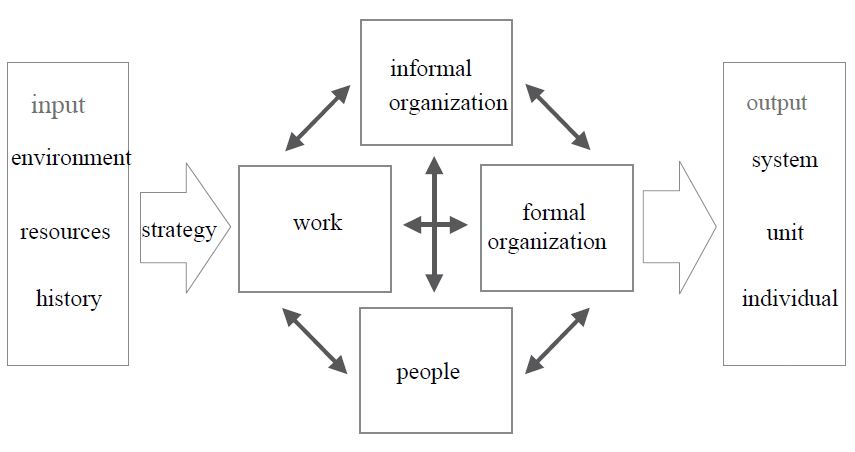
When HP and Compaq decided to combine forces, they used schematics like the one below to help them discuss the salient issues–

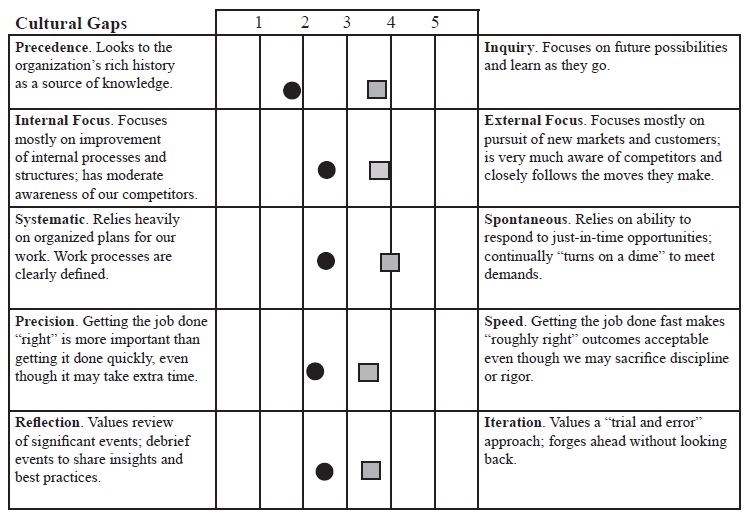
After looking through these issues and discussing each company’s culture, the merger team put together a chart like the one below to begin developing tactics to plan for a smooth post-closing integration.

As you look at this chart, think about key M&A transactions in your industry or local community. Of the ones that did not pan out as planned, do you think they would have stood a better chance had they systematically worked through these type issues during due diligence?

Cultural due diligence is vital to successful M&A processes. If earnest consideration were given to culture as it is to financial and other factors, inorganic growth and increased market share would be a realized outcome far more often!

(Thanks go out to Agata Stachowicz-Stanusch, who wrote of the value of cultural due dilgence and detailed a case study of the HP-Compaq merger in the Journal of Intercultural Management’s April, 2009 edition.)